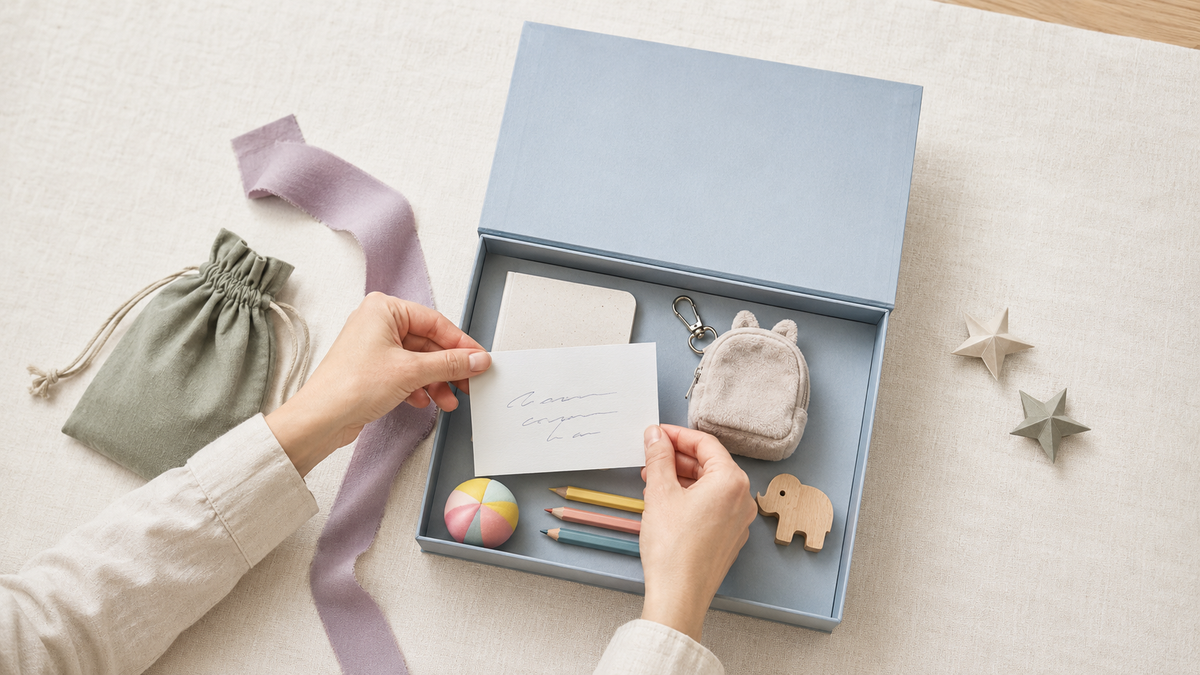
A gift box feels special before the child even knows what is inside.
There are layers to open. Small discoveries. A sense that every piece belongs to the same little world. Instead of receiving one object, the child experiences a story unfolding item by item.
The best children’s gift boxes are not filled with as many products as possible.
They are built around one thoughtful idea:
-
something the child loves;
-
something they can do;
-
something useful;
-
something surprising;
-
something that shows you noticed who they are.
You do not need professional gift wrapping or an enormous budget. With two to four carefully connected products, a reusable container and a personal message, you can create a gift that feels genuinely made for one particular child.
Quick answer: What should go inside a children’s gift box?
A balanced gift box usually contains:
-
One hero gift — the main toy or activity.
-
One playful extra — a smaller surprise or collectable.
-
One useful item — something for school, travel, storage or daily routines.
-
One personal touch — a note, challenge, photograph or homemade card.
You do not need all four. One main gift, one small extra and a handwritten message can be enough.
Choose every product according to the child’s age and interests. Check safety warnings, materials, dimensions and compatibility before assembling the box.
Why a themed gift box feels more personal
Three random toys still feel like three random toys, even when they are arranged beautifully.
A themed gift box creates a connection between the items. It tells the child why they were chosen.
For example:
-
a squishy, small pouch and collector card become a Sensory Surprise Box;
-
pencils, a notebook and creative activity become a Little Artist Box;
-
a bottle, notebook and nature toy become a Young Explorer Box;
-
a cape, wand and handmade story prompt become a Magical Adventure Box.
The theme gives the child an immediate starting point without controlling the play.
It says:
“Here is a world you might enjoy entering.”
Step 1: Begin with the child—not the products
Before browsing, write down three things about the child.
Their age
This helps you avoid:
-
small parts for children under three;
-
activities requiring abilities they have not developed;
-
gifts that feel too young;
-
products intended for a later stage.
Use official manufacturer guidance rather than appearance. A simple-looking toy may still be marked 3+.
Their strongest current interest
Think specifically:
-
animals;
-
space;
-
drawing;
-
building;
-
magic;
-
food play;
-
movement;
-
photography;
-
collecting;
-
nature;
-
school accessories.
“Likes toys” is not enough to guide a personal box.
How they naturally play
Do they prefer:
-
quiet or active play;
-
clear challenges or open-ended stories;
-
creating or collecting;
-
playing alone or with others;
-
predictable choices or surprises?
The same theme can be adapted to different play styles.
A child who loves animals and quiet play may enjoy a soft fox and a book. A highly active animal lover may prefer an explorer bottle and outdoor activity.
Step 2: Choose one hero gift
The hero gift anchors the box.
It should be the item with the clearest connection to the child’s interests—not necessarily the most expensive.
A hero gift might be:
-
a creative activity;
-
a wooden toy;
-
a larger squishy;
-
a camera;
-
a soft character;
-
a costume piece;
-
a puzzle;
-
a practical school item;
-
an age-appropriate sensory toy.
Keep the scale realistic
The main product needs to fit comfortably inside the chosen box with enough room for supporting pieces.
Do not select a giant item and then attempt to disguise the shipping carton with one ribbon. That is no longer a gift box. It is a logistical event.
If the hero gift is large, place only a small card or symbolic extra inside the presentation box and give the main item separately.
Step 3: Add one playful surprise
The supporting item should complement the hero gift rather than compete with it.
Examples:
-
a small squishy beside a larger sensory toy;
-
a backpack charm with a school bag;
-
pencils with a creative kit;
-
a soft character with a storytelling gift;
-
a camera refill for a compatible camera;
-
a small notebook with an explorer set.
A surprise works especially well when it is discovered inside another item:
-
a note inside the pencil case;
-
a small charm tucked into a pouch;
-
a collector card beneath the squishy;
-
a challenge placed inside the notebook.
Check that small surprises are safe for the child’s age.
Step 4: Add something useful
A practical item gives the box a life beyond the birthday moment.
It might be:
-
a reusable bottle;
-
pencil case;
-
storage pouch;
-
notebook;
-
lunch accessory;
-
small backpack;
-
container for a collection;
-
child-sized feeding item;
-
craft-material organiser.
Practical does not have to mean boring.
The right useful product can reflect the child’s favourite animal, colour or character and become part of an important milestone.
Step 5: Add a human touch
This is the element children may keep long after the packaging disappears.
Write something that belongs only to them:
-
“For all the worlds you haven’t invented yet.”
-
“A small box for a very curious explorer.”
-
“These creatures heard you were starting a collection.”
-
“For quiet afternoons and very big ideas.”
-
“Open whenever an ordinary day needs more magic.”
For older children, avoid language that feels too young. A simple, sincere note works better than forced cuteness.
You can also add:
-
a photograph;
-
a homemade ticket;
-
a small map;
-
an activity challenge;
-
a collector card;
-
a promise to play together;
-
a voucher for a shared outing.
1. The Sensory Surprise Box
This gift box centres on tactile play, funny characters and discovery.
What to include
-
one hero squishy;
-
one smaller textured toy;
-
a pouch or small basket;
-
a homemade character card.
The Giant Dumpling Squishy or Giant Strawberry Squishy can become the main character.
Add a compact Textured Sensory Fuzz Ball or Small Paw Squishy if appropriate for the child’s age.
Personal touch
Create an adoption card:
-
Name:
-
Favourite snack:
-
Special talent:
-
Most unusual adventure:
Allow the child to complete the answers.
Best for
-
children aged three and over;
-
collectors;
-
travel gifts;
-
birthdays;
-
screen-free mini activities.
Squishies are not food and should not be eaten, bitten or chewed. Inspect them regularly and remove damaged toys from use.
2. The Mystery Unboxing Box
For some children, not knowing is half the fun.
The Surprise Squishy Box includes a random assortment, with options of 8, 12, 16 or 26 pieces.
The smallest version can act as the entire gift, or a larger assortment can be divided into smaller reveal stages.
How to present it
-
Wrap individual pieces in tissue paper.
-
Number the layers.
-
Invite siblings to take turns.
-
Add simple guessing cards.
-
Create a “favourite reveal” voting card.
Do not promise a specific character or colour. Random selection is central to the product.
Best for
-
children who enjoy surprises;
-
siblings;
-
party activities;
-
collectors;
-
children comfortable with random assortments.
This is less suitable for a child who wants one exact design or finds uncertainty stressful.
3. The Little Artist Box
A creative gift box should provide an invitation, not another assignment.
What to include
-
one age-appropriate creative activity;
-
selected pencils or crayons;
-
a notebook or sketchbook;
-
a pencil case;
-
one unusual prompt.
Explore Arts, Crafts & DIY and choose a project suited to the child’s age and interests.
Creative prompts
-
Draw an animal nobody has discovered.
-
Design a home for a cloud.
-
Create the funniest breakfast in the world.
-
Make a postcard from an imaginary planet.
-
Draw yourself as the hero of a new story.
Best for
-
children who love drawing;
-
rainy-day gifts;
-
school-age children;
-
screen-free play;
-
siblings who enjoy making things together.
Avoid overwhelming the box with too many materials. A limited, coherent palette can feel more inviting than a container overflowing with options.
4. The Young Photographer Box
A photography box gives a child tools for noticing the world.
The Hoppstar Rookie Kids Digital Camera is recommended from age three and designed for smaller hands.
What to include
-
compatible child-friendly camera;
-
suitable carrying case;
-
memory card where required and supported;
-
one photography challenge card;
-
a small notebook for captions.
For compatible instant-print models, paper refills may make a useful supporting gift. Verify the exact camera model before purchasing accessories.
Photography challenge
Invite the child to capture:
-
five tiny wonders;
-
three signs of the current season;
-
one object from an unusual angle;
-
four pictures that tell a story;
-
every colour of the rainbow;
-
portraits of favourite toys.
Best for
-
creative children;
-
young explorers;
-
holidays;
-
older children who prefer a real hobby to a conventional toy.
Explain privacy and ask permission before photographing other people.
5. The Little Explorer Box
This box turns a walk into an expedition.
What to include
-
a small backpack;
-
reusable bottle;
-
notebook and pencils;
-
nature-inspired toy;
-
homemade observation cards.
The Mr. Dragon Stainless Steel Bottle has a 350 ml capacity and carrying loop.
The Educational Wooden Bee Life Block Set introduces plants important to bees and other pollinators.
Observation-card ideas
-
Find three leaf shapes.
-
Listen for five sounds.
-
Draw the smallest thing you notice.
-
Look for an insect without touching it.
-
Find something rough, smooth and soft.
-
Choose one tree to visit again next season.
Best for
-
nature lovers;
-
curious children;
-
family outings;
-
screen-free adventures;
-
children who ask many “why” questions.
Teach children to observe nature without disturbing animals or removing protected plants.
6. The Magical Adventure Box
The hero of this box is not a licensed character.
It is the child.
What to include
-
an open-ended cape or costume accessory;
-
a textile wand or simple prop;
-
one soft or wooden character;
-
a rolled story invitation.
The Cosmic Pearl Magic Cape supports dress-up and fantasy play without prescribing one fixed role.
Story invitation
A doorway appeared last night.
Nobody knows where it leads.
Only someone wearing this cape can open it.
Stop there.
The child should decide the rest.
Best for
-
dreamers;
-
storytellers;
-
preschoolers;
-
children who enjoy costumes;
-
siblings who create imaginary worlds.
Explore Dress-Up & Pretend Play.
7. The Storyteller Box
This box provides characters and a setting, but leaves the plot unfinished.
What to include
-
puppet or soft character;
-
simple costume accessory;
-
blank mini book;
-
handmade theatre tickets;
-
one story-opening card.
A larger gift such as the Wooden Circus Puppet Theater can be given separately, with the smaller storytelling pieces inside the box.
Story beginnings
-
“The circus woke up and every animal had changed colour.”
-
“A fox found a key beneath the moon.”
-
“Nobody had ever opened the tiny blue door.”
-
“The dragon wanted to become a baker.”
-
“The show could not begin because the star had disappeared.”
Best for
-
imaginative children;
-
family play;
-
language-rich activities;
-
children who love performing;
-
gifts shared by siblings.
Prepare yourself to attend the premiere. The director may not allow late seating.
8. The Calm Moments Box
This box is for quiet activities without promising to “calm” the child on demand.
What to include
-
a small tactile toy;
-
age-appropriate puzzle;
-
notebook or simple drawing materials;
-
soft companion;
-
reusable fabric pouch.
It can be used during:
-
travel;
-
quiet afternoons;
-
visits;
-
waiting periods;
-
time away from a busy group.
Do not market general toys as medical or therapeutic products. The box simply offers low-setup activities a child may enjoy at their own pace.
Best for
-
quiet thinkers;
-
travellers;
-
children who enjoy tactile play;
-
small “thinking of you” gifts;
-
keeping at a grandparent’s home.
9. The First School Day Box
A school gift box can turn practical preparation into a milestone.
What to include
-
pencil case;
-
bottle;
-
backpack charm;
-
notebook;
-
encouragement card.
For a larger set, add a backpack or insulated lunch bag separately.
The Mr. Lion Thermal Lunch Bag can hold a lunch box, bottle and snacks. Verify that all selected items fit together before ordering.
Encouragement card
You do not need to know everything on the first day.
You can ask for help, take your time and try again.
We cannot wait to hear about the little things you noticed.
Best for
-
starting nursery;
-
preschool;
-
first year of school;
-
joining a new club;
-
changing schools.
Explore Kids’ Backpacks & Bags.
10. The First Birthday Discovery Box
A gift box for a one-year-old must be built around safety rather than variety.
What to include
-
soft stacking toy;
-
large sensory block;
-
age-appropriate rattle;
-
practical feeding item;
-
letter for the child to read later.
The Handmade Textile Stacking Rings Toy is suitable from birth.
The Wooden Koala Rattle is also recommended from birth.
Important
Do not include:
-
products marked 3+;
-
small collectables;
-
squishies intended for older children;
-
loose decorations;
-
long ribbons within the child’s reach;
-
confectionery inappropriate for the age;
-
objects selected only because the child will “grow into them.”
The wrapping itself must also remain under adult control.
Best for
-
first birthdays;
-
grandchildren;
-
godchildren;
-
a small group gift from relatives.
11. The Animal Lover Box
Choose one animal family rather than filling the box with unrelated creatures.
Possible themes:
-
woodland;
-
ocean;
-
farm;
-
dinosaurs;
-
pets;
-
insects and pollinators.
What to include
-
one soft animal;
-
animal-inspired accessory;
-
small nature activity;
-
story card;
-
reusable storage basket.
GRAVITALY JOURNAL