Screens are part of modern family life. They help children learn, communicate, relax and explore—but sometimes everyone needs a pause from the glowing rectangle.
The challenge is not simply to take a screen away. It is to offer something interesting enough to replace it.
The best screen-free toys do not try to compete with digital entertainment through louder sounds, brighter lights or constant instructions. They invite children to become active participants: building, moving, imagining, photographing, drawing, solving and inventing their own games.
A good screen-free toy gives a child somewhere to begin, while leaving enough freedom for the play to become their own.
Quick answer: What are the best screen-free toys for children?
The best screen-free toys include:
- open-ended wooden toys;
- building blocks and construction sets;
- puzzles and sorting toys;
- art and craft activities;
- children’s cameras;
- dress-up and pretend-play accessories;
- play tents and hideaways;
- balance and climbing equipment;
- outdoor exploration toys;
- sensory and fidget toys;
- soft toys for storytelling;
- age-appropriate baby activity toys.
Choose according to the child’s age, interests, abilities and available play space. A toy is more likely to replace screen time successfully when it connects with something the child already enjoys.
Explore screen-free toys at Gravitaly, or continue reading to find the right type of play for your child.
What makes a good screen-free toy?
Removing a device does not automatically create meaningful play.
A toy must give the child a clear invitation: something to touch, change, solve, create or imagine. The strongest options usually offer at least one of the following:
The child controls the experience
A wooden block does not decide what it is. Today it can be part of a tower; tomorrow it may become a cake, bridge or home for a tiny animal.
There is more than one possible outcome
A puzzle generally has one solution. A construction set can have hundreds. Both can be valuable, but open-ended materials often support longer and more varied play.
The activity matches the child’s current interests
A first camera may fascinate an observant child. A costume cape may be more engaging for a storyteller. A balance beam may suit a child who turns every pavement edge into a physical challenge.
The toy is easy to begin using
If play requires a long setup, several missing accessories or constant adult instruction, children may return quickly to the easier option—the screen.
It can grow with the child
The best toys are not necessarily the most complex. They are the ones children can revisit with new skills, ideas and stories.
1. Open-ended wooden building toys
Wooden blocks are among the simplest screen-free toys, and that simplicity is their strength.
They allow children to explore:
- balance;
- shape;
- size;
- symmetry;
- cause and effect;
- spatial relationships;
- imaginative storytelling.
The Classic Wooden Puzzle Blocks – Long and Short can be sorted, stacked and compared while encouraging children to notice differences in size.
The Educational Wooden Bee Life Block Set adds a nature theme by introducing plants that are important to bees and other pollinators.
Instead of showing a child exactly what to build, try a gentle challenge:
- Build something taller than your favourite book.
- Make a home for a tiny animal.
- Create a bridge between two cushions.
- Use every piece without making a tower.
- Build something that looks different from every side.
Best for: builders, problem-solvers and children who enjoy testing their own ideas.
2. Stacking and balancing toys
Placing one object on another sounds simple. For a young child, it can involve concentration, coordination, patience and many small adjustments.
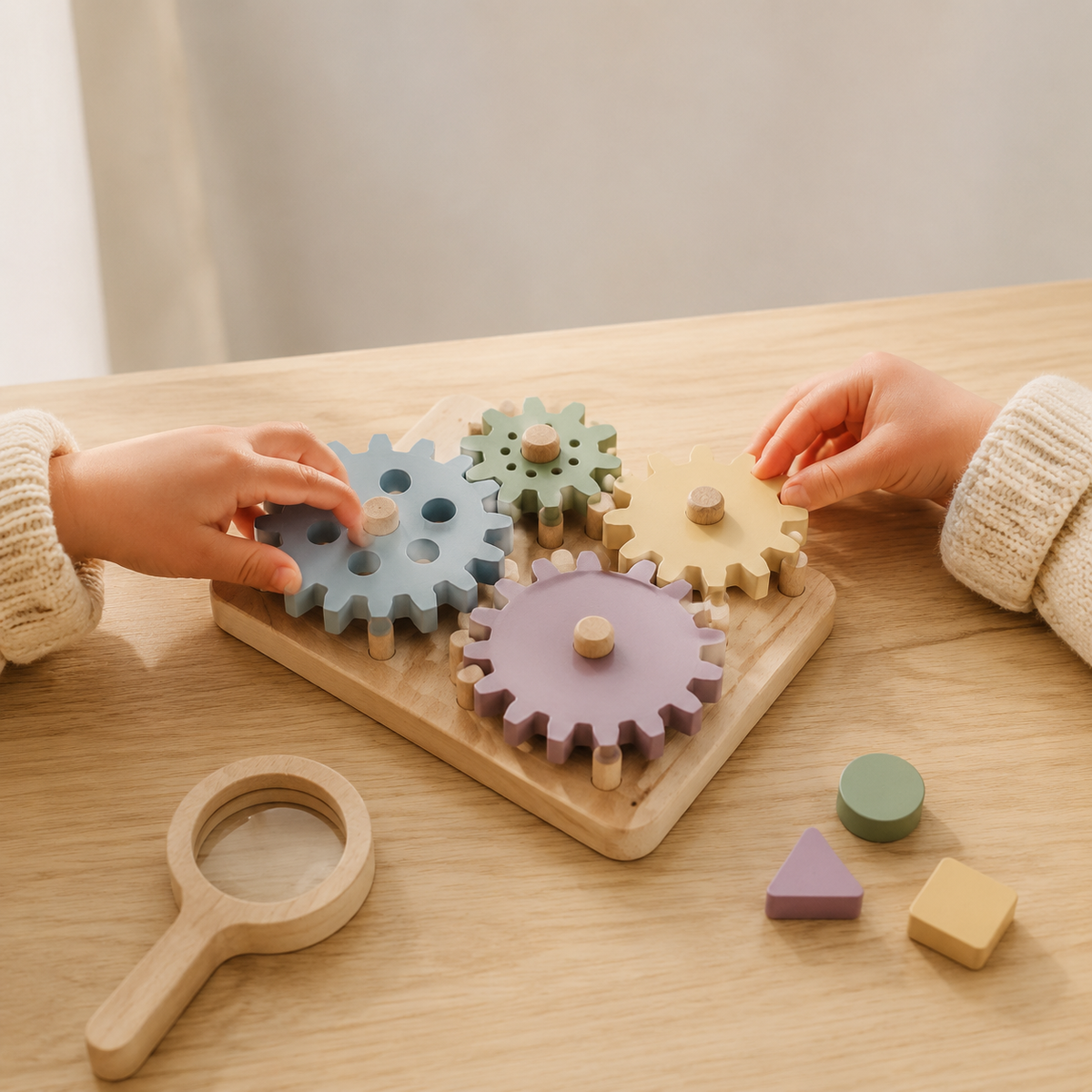
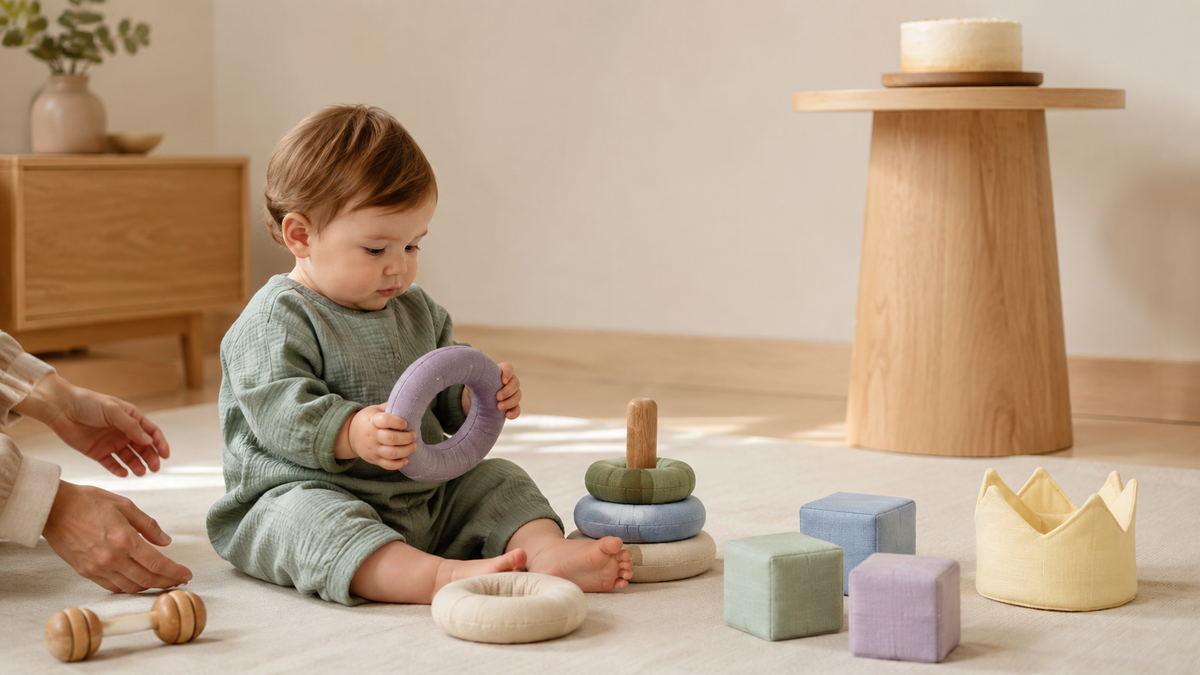
The Montessori-Inspired Modern Stacking Toy combines geometric forms with a calm, Bauhaus-inspired colour palette. Children can arrange and balance the pieces rather than follow only one fixed construction.
A stacking toy may become:
- a tower;
- an imaginary city;
- a colour-sorting activity;
- furniture for small characters;
- part of a pretend shop;
- a balancing experiment.
Allowing the structure to fall is part of the experience. The wobble, collapse and decision to try again are often more valuable than producing a perfect finished tower.
Best for: quiet play, repeated experimentation and children who like arranging objects.
3. Puzzles that offer the right level of challenge
Puzzles provide a clear purpose and a satisfying endpoint. They can be particularly useful when children want a focused activity that feels manageable.
Choose a puzzle that is challenging enough to hold attention but not so difficult that the child needs an adult to complete every step.
The Vibrant Wooden Fence Puzzle offers wooden pieces with smooth, rounded edges and can support visual matching and spatial reasoning.
When choosing a puzzle, consider:
- the number and size of the pieces;
- the child’s previous puzzle experience;
- whether the image or theme interests them;
- how easily the pieces can be handled;
- whether the puzzle has one use or additional play possibilities.
Avoid correcting every misplaced piece immediately. A little time to inspect, rotate and retry allows the child to make the discovery independently.
Best for: focused children, pattern lovers and quiet afternoon play.
4. Art and craft activities
Creative activities are often recommended as alternatives to screen time, but a huge box overflowing with materials can be less inviting than a simple, carefully prepared project.
Begin with a limited selection:
- quality pencils or crayons;
- paper or a small sketchbook;
- one age-appropriate creative kit;
- a pencil case or organiser;
- one unusual prompt.
Explore Arts, Crafts & DIY for projects that suit the child’s age and interests.
Instead of asking, “What are you drawing?”, try a more imaginative invitation:
- Invent an animal that lives in the clouds.
- Design a bedroom for a dragon.
- Draw the smallest adventure in the world.
- Create a menu for a monster café.
- Make a postcard from an imaginary planet.
The goal is not to produce something beautiful enough for the wall. It is to help the child experience the pleasure of making a decision and seeing an idea take shape.
Best for: artists, storytellers and children who enjoy making things with their hands.
5. A first camera for real-world discovery
A children’s camera technically contains a screen, but its purpose is different from passive screen entertainment. It encourages the child to look outward, move through the real world and notice details.
The Hoppstar Rookie Kids Digital Camera is designed for young children and features simple point-and-shoot operation, a rechargeable battery and support for a memory card.
Use it to create screen-light activities such as:
- a colour scavenger hunt;
- portraits of favourite toys;
- a photographic alphabet;
- a family walk documented from the child’s perspective;
- a four-picture story;
- a gallery of tiny things adults usually overlook.
A compatible silicone protective case or compact camera bag can help turn the camera into a complete gift for a young explorer.
Children should also learn to ask permission before photographing other people.
Best for: observers, young travellers and children who love telling stories.
6. Dress-up and pretend-play accessories
A cape, wand or simple costume accessory can open the door to an entire imaginary world.
Unlike a toy that performs one predetermined sequence, dress-up play asks the child to decide:
- Who am I?
- Where am I going?
- What problem must I solve?
- Who else is part of the story?
- What happens next?
Browse Dress-Up & Pretend Play for open-ended accessories that can support different characters and stories.
A costume does not need to reproduce one licensed character exactly. A more flexible cape can belong to a magician today, an explorer tomorrow and the guardian of an underwater kingdom next week.
Add a handwritten story opening:
A tiny door appeared behind the bookshelf last night.
Only the person wearing this cape can open it.
Then let the child direct the rest.
Best for: performers, storytellers and children with vivid imaginations.
7. Play tents and hideaways
A play tent can support energetic imaginary adventures one moment and become a quiet reading retreat the next.
Explore Play Tents & Hideaways for spaces that can become:
- a campsite;
- a shop;
- a puppet theatre;
- a veterinary clinic;
- a secret reading den;
- a calm corner after a busy day.
Keep the interior simple. One cushion, two books and a favourite soft toy may be more inviting than a tent packed with objects.
Children often enjoy deciding what the space should become. Leaving part of it unfinished gives them ownership of the idea.
Before buying, check the assembled dimensions and make sure the family has a practical place to use and store it.
Best for: imaginative play, reading and children who enjoy having a small space of their own.
8. Balance beams for active indoor play
Some children do not need another seated activity. They need to move.
The Wooden Balance Beam with 5 Elements can be arranged into different paths and stacked more compactly when not in use. The pieces can also become roads or boundaries during imaginative play.
The 6-Element Wooden Balance Beam offers additional possibilities for a longer course.
Try transforming the path into:
- a bridge across an imaginary river;
- a mountain trail;
- a delivery route for toy animals;
- part of a living-room obstacle course;
- a road between two block-built towns.
Check the product’s age recommendation, weight limit and safety instructions. Active play should take place on a suitable surface with the supervision appropriate for the child.
Best for: energetic children, confident walkers and indoor movement breaks.
9. Climbing and movement toys
Climbing structures, rockers, slides and balance equipment can provide a constructive outlet when children have been sitting for too long.
Explore Climbing & Balance for products designed around whole-body play.
These are substantial purchases, so consider:
- the child’s current physical ability;
- available floor space;
- safe clearance around the product;
- storage;
- required supervision;
- whether siblings will use it together;
- maximum recommended weight.
A versatile active-play product may become a climbing challenge, tunnel, bridge, slide or imaginary landscape. That flexibility helps it remain useful beyond the first burst of excitement.
Best for: active preschoolers, indoor playrooms and shared family gifts.
10. Sensory and squishy toys
Screen-free play does not always require an elaborate activity.
Sometimes a child wants something satisfying to squeeze, press or explore with their hands.
The Giant Dumpling Squishy is a large 20 cm characterful sensory toy designed for squeezing, collecting and screen-free play.
Smaller squishies and fidget toys can also work well for:
- travel;
- waiting times;
- quiet play beside an adult;
- party gifts;
- small rewards;
- personalised gift boxes.
Explore the complete Squishy & Fidget Toys collection.
Always follow the product’s age guidance. Squishies are not food and should not be eaten, bitten or chewed. Inspect them regularly and remove damaged products from play.
Best for: tactile explorers, collectors and children who enjoy immediate hands-on play.
11. Montessori busy boards
A busy board brings several practical actions together in one place. Depending on the design, children may practise fastening, turning, opening, closing or manipulating familiar mechanisms.
The Large Montessori Busy Board creates a substantial activity point for a nursery or playroom.
Busy boards are most useful when:
- the individual elements are suitable for the child’s age;
- the board is installed or positioned according to its instructions;
- the child can reach it comfortably;
- adults allow time for independent experimentation;
- it remains accessible instead of being stored out of sight.
Rather than demonstrating every mechanism, show one if necessary and allow the child to investigate the others.
Best for: curious toddlers and children interested in real-world mechanisms.
12. Soft construction sets
Not every building project needs hard wooden pieces.
The 21-Piece Soft Play Block Set with Wheels gives children construction pieces that can be combined into different forms.
Soft building toys can be helpful for children who enjoy:
- constructing on the floor;
- combining vehicles and buildings;
- collaborative play;
- rebuilding quickly;
- inventing scenes around their creations.
Offer challenges without supplying a full solution:
- Can you build something that moves?
- Can two characters fit inside?
- Can you create a vehicle nobody has seen before?
- Can you use every wheel?
Best for: young builders, siblings and collaborative play.
13. Nature and outdoor exploration toys
The outdoors already provides changing light, textures, sounds, movement and discoveries. A carefully chosen toy or tool can help a child notice more without controlling the experience.
Explore Outdoor Fun and consider pairing a product with a simple observation challenge:
- Find three different leaf shapes.
- Listen for five sounds.
- Photograph something smaller than your thumb.
- Draw the path you followed.
- Look for signs of insects without disturbing them.
- Find something rough, smooth and soft.
The aim is not to turn every walk into a lesson. It is to encourage slower looking and genuine curiosity.
Teach children to observe animals and plants without harming, collecting or disturbing them.
Best for: explorers, nature lovers and family outings.
14. Soft toys as storytelling companions
A soft toy can appear less “educational” than a puzzle or building set, yet it can become part of rich imaginative and emotional play.
Children may use a soft character to:
- recreate a familiar experience;
- invent conversations;
- practise caring routines;
- build a story;
- create a show;
- bring comfort into an unfamiliar situation.
Instead of giving the character a complete personality, invite the child to decide:
- What is its name?
- Where did it come from?
- What is it afraid of?
- What does it do unusually well?
- Where would it like to travel?
Browse Soft Toys for characters that can become part of play, reading and a child’s room.
Best for: storytellers, nurturing play and quiet companionship.
15. A curated screen-free activity basket
You do not always need one large new toy.
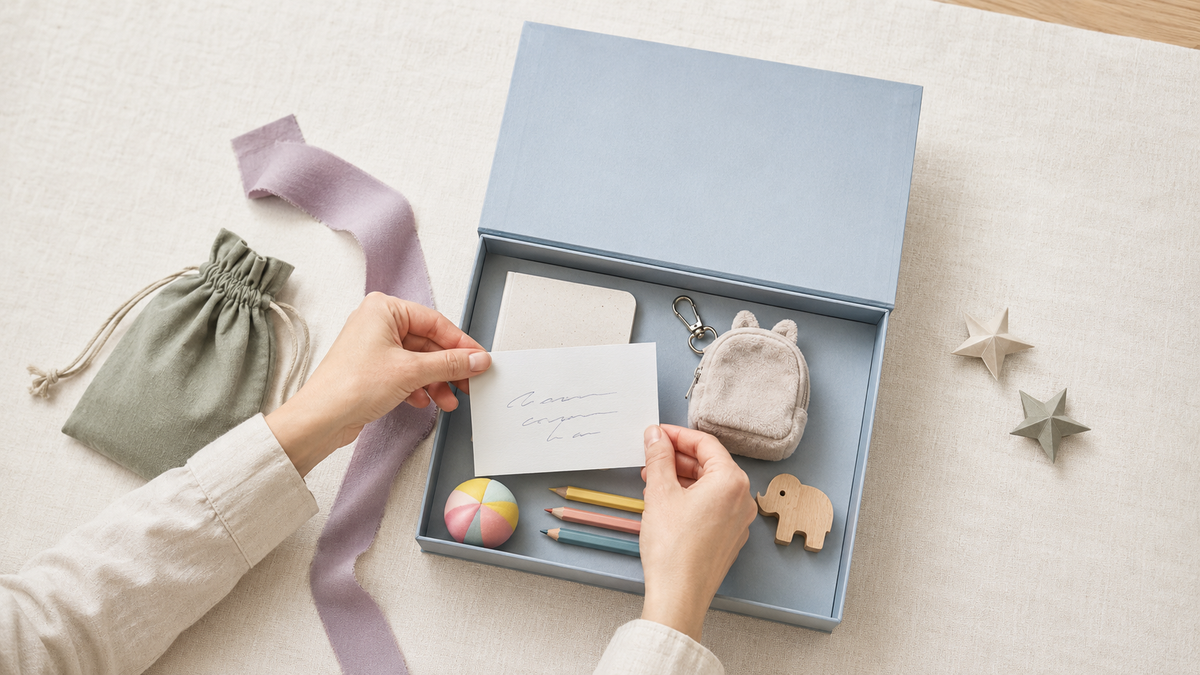
A small basket containing three or four familiar activities can make independent play easier to begin. The important part is curation, not quantity.
Try combining:
- one small puzzle;
- a sketchbook and selected pencils;
- one tactile toy;
- a few wooden building pieces;
- a soft character;
- three homemade challenge cards.
Rotate some of the contents rather than adding more and more. A toy that has been out of sight for a while may feel new again when it returns.
Place the basket where the child can reach it independently and use a simple invitation:
“This basket is here if you feel like making, building or discovering something.”
Best for: quiet afternoons, transitions and families reducing passive screen habits gradually.
How to choose by the child’s natural play style
If you are unsure where to begin, observe what the child already does when no one directs them.
For the child who loves to move
Consider:
- balance beams;
- climbing toys;
- rockers;
- ride-ons;
- outdoor exploration.
For the child who builds
Consider:
- wooden blocks;
- stacking toys;
- construction sets;
- puzzles;
- Montessori sorting toys.
For the child who creates
Consider:
- arts and crafts;
- drawing materials;
- a first camera;
- textile projects;
- open-ended creative kits.
For the child who tells stories
Consider:
- dress-up accessories;
- play tents;
- puppet theatres;
- soft characters;
- wooden figures.
For the child who enjoys quiet tactile play
Consider:
- squishies;
- fidget toys;
- puzzles;
- busy boards;
- small activity baskets.
The same child may move between several styles. These are starting points, not fixed labels.
GRAVITALY JOURNAL