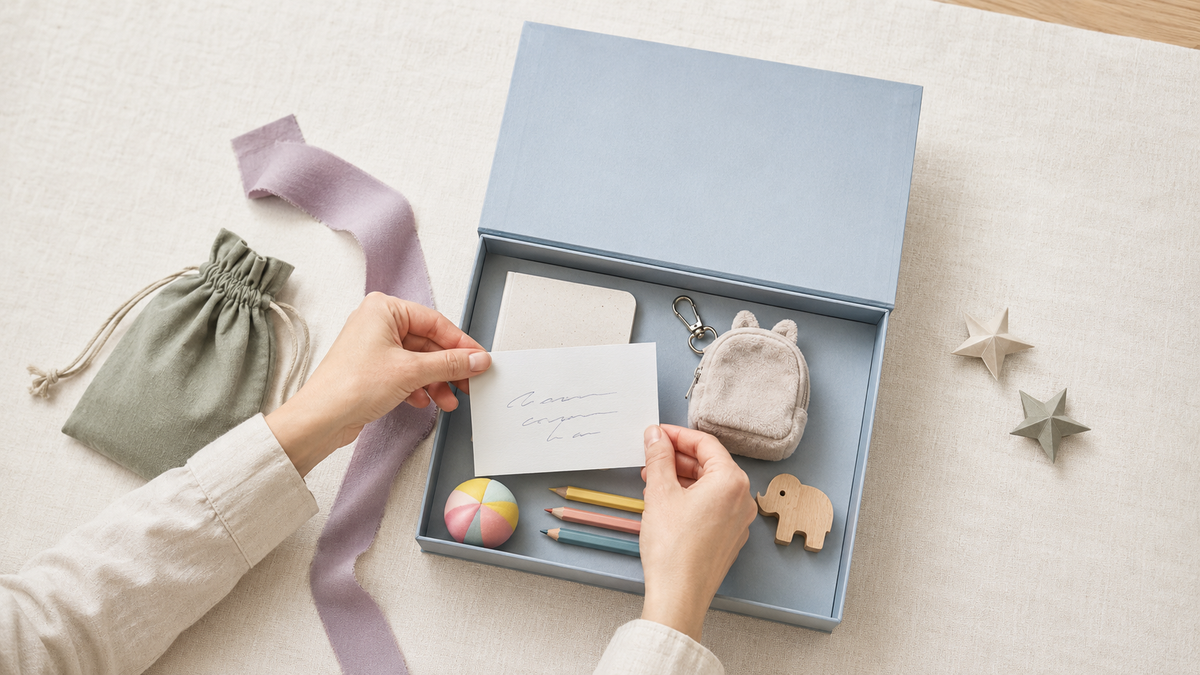
A children’s gift box feels special before the first present has even been opened. There are layers to discover, small surprises and the sense that every item was chosen for one particular child.
The best gift boxes are not filled with as many products as possible. They are built around one clear idea and contain a few things that genuinely belong together.
You do not need professional gift wrapping or an enormous budget. With one main gift, one or two thoughtful extras and a personal message, you can create something that feels considered rather than crowded.
Quick answer: What should go in a child’s gift box?
A balanced children’s gift box can contain:
- One hero gift — the main toy, activity or useful item.
- One playful extra — a small surprise connected to the theme.
- One practical item — something useful for school, travel or everyday routines.
- One personal touch — a note, photograph, challenge card or handmade detail.
You do not need all four elements. One well-chosen main gift, a small extra and a handwritten message can be enough.
Before buying anything, check the child’s age, interests and preferred style of play. Every product must also be reviewed individually for age guidance, materials, dimensions and safety warnings.
Why a themed gift box feels more personal
Three unrelated toys still feel like three unrelated toys, even when they are wrapped beautifully.
A theme creates a connection between the items and gives the child an immediate idea for play. For example:
- A sketchbook, pencils and a creative activity become a Little Artist Box.
- A sensory toy, small pouch and character card become a Sensory Surprise Box.
- A bottle, notebook and nature challenge become a Young Explorer Box.
- A cape, mask and story card become a Magical Adventure Box.
- A backpack, bottle and charm become a Preschool Starter Box.
The theme should offer a starting point without deciding exactly how the child must use each item.
Step 1: Start with the child
Before browsing products, write down three things about the child.
Their age
Age guidance helps you avoid gifts that contain unsuitable small parts, require abilities the child has not yet developed or feel too young for their current interests.
Always follow the manufacturer’s official age recommendation. A simple-looking product may still contain components intended for older children.
Their current interests
Try to be specific. Instead of writing “likes toys”, consider whether the child is currently interested in:
- Animals
- Drawing and making
- Building
- Space
- Nature
- Photography
- Magic and pretend play
- Vehicles
- Collecting
- Sensory play
- School accessories
- Outdoor adventures
Children’s interests change, but a gift connected to something they care about now is more likely to feel personal.
How they like to play
Think about whether the child tends to prefer:
- Quiet or active play
- Creating or collecting
- Clear challenges or open-ended stories
- Independent or shared activities
- Familiar choices or surprises
Two children who both love animals may want completely different gifts. One might enjoy drawing them, while another would rather take an animal-themed bottle on an outdoor adventure.
Step 2: Choose one hero gift
The hero gift anchors the box. It should have the clearest connection to the child’s interests, although it does not have to be the most expensive item.
Depending on the child, it might be:
- A creative activity
- An open-ended wooden toy
- A child-friendly camera
- A costume or role-play accessory
- A larger sensory toy
- A practical preschool item
- A puzzle or building set
- A soft companion
- An age-appropriate discovery activity
Check that the main gift fits comfortably inside the box. If it is too large, give it separately and place a small card, accessory or clue inside the presentation box.
Trying to disguise a climbing structure as a gift box is less a wrapping project and more a logistical event.
Step 3: Add one connected surprise
The supporting item should extend the theme rather than compete with the main gift.
Good combinations include:
- A small sensory toy with a larger tactile gift
- Pencils with a creative activity
- A charm with a backpack
- A notebook with a child-friendly camera
- A mask with a dress-up cape
- A soft character with a storytelling activity
- An observation card with an explorer set
A small surprise can also be hidden inside another item: a note inside a pencil case, a charm inside a pouch or a challenge card between the pages of a notebook.
Check that every small item is appropriate for the child’s age.
Step 4: Include something useful
A practical item gives the gift box a life beyond the birthday or celebration.
Consider adding:
- A reusable water bottle
- A pencil case
- A notebook
- A small storage pouch
- A lunch accessory
- A backpack
- A container for a growing collection
- A simple organiser for creative materials
Practical does not have to mean dull. A useful item in a favourite colour or animal design can become the part of the box the child uses most often.
Browse kids’ backpacks and bags and reusable water bottles and cups for everyday additions.
Step 5: Add a personal message
The most memorable element may cost nothing.
Write a message that could only belong to that child:
- “For all the worlds you haven’t invented yet.”
- “A little box for a very curious explorer.”
- “For quiet afternoons and very big ideas.”
- “These creatures heard you were starting a collection.”
- “Open whenever an ordinary day needs more magic.”
You could also include:
- A photograph
- A homemade ticket
- A small treasure map
- An activity challenge
- A collector card
- A promise to play together
- A voucher for a shared outing
For older children, keep the message sincere and avoid language that feels too young.
Six children’s gift box ideas
The following themes can be adapted to different ages, budgets and interests.
1. The Little Artist Box
A creative box should feel like an invitation, not another assignment.
What to include
- One age-appropriate creative activity
- A small selection of pencils, crayons or drawing tools
- A notebook or sketchbook
- A pencil case or material pouch
- One unusual creative prompt
You can explore Arts, Crafts & DIY activities and choose a project suited to the child’s current abilities.
Creative prompt ideas
- Draw an animal nobody has discovered yet.
- Design a home for a cloud.
- Create the funniest breakfast in the world.
- Make a postcard from an imaginary planet.
- Draw yourself as the hero of a new story.
Avoid filling the box with too many materials. A small, coherent selection often feels more inviting than an overflowing container.
Best for: children who love drawing, making and experimenting with colour.
2. The Sensory Surprise Box
This box is built around texture, tactile play and a little element of discovery.
What to include
- One hero sensory toy
- One smaller tactile surprise
- A pouch or reusable container
- A homemade character or collector card
If the child enjoys surprises, the Surprise Squishy Box can work as the main gift rather than requiring several unrelated additions.
Do not promise a specific character or colour when the product is sold as a random assortment. Surprise-based gifts are less suitable for children who want one exact design or find uncertainty uncomfortable.
Squishies and food-shaped sensory toys are not food. They should not be bitten, chewed or swallowed. Inspect them regularly and stop using any damaged product.
Best for: tactile explorers, collectors and children who enjoy unboxing surprises.
3. The Young Explorer Box
This theme turns a walk, holiday or afternoon outside into a small expedition.
What to include
- A lightweight backpack
- A reusable bottle
- A notebook and pencils
- A nature-inspired toy or activity
- Homemade observation cards
Observation-card ideas
- Find three different leaf shapes.
- Listen for five sounds.
- Draw the smallest thing you notice.
- Find something rough, something smooth and something soft.
- Look for an insect without touching it.
- Choose one tree to visit again next season.
The point is not to complete every challenge. The cards simply help the child slow down and notice details.
Best for: nature lovers, curious children and families who enjoy outdoor time.
4. The Magical Adventure Box
A dress-up box gives the child the beginning of a story and leaves the rest to their imagination.
What to include
- A cape, mask or simple costume accessory
- One small prop
- A handwritten character card
- A map or secret mission
- A pouch for keeping the accessories together
Browse dress-up and pretend-play gifts for versatile pieces that can become part of many stories.
Instead of explaining exactly how to play, add a question:
“Who wears this cape, and what important adventure are they about to begin?”
Then allow the child to decide.
Check costumes for loose decorations, long ties, restricted vision and other age-specific warnings. Dress-up accessories should be removed before sleep.
Best for: performers, storytellers and children with vivid imaginations.
5. The Preschool Starter Box
A practical milestone can still feel celebratory.
What to include
- A preschool backpack
- A reusable bottle
- A lunch box or snack container
- A backpack charm
- A simple name card or first-day note
Choose the main items according to the child’s size and everyday needs. Check backpack measurements, bottle capacity, closures and care instructions before combining them.
A preschool starter box is especially meaningful when the child can choose between two suitable colours or animal designs. This gives them some ownership without presenting an overwhelming number of options.
Best for: children starting nursery, preschool or regular family outings.
6. The Quiet-Time Story Box
Not every gift box needs to be bright, busy or full of surprises. A calmer theme can create a small ritual for reading, storytelling or unwinding together.
What to include
- A favourite or carefully chosen book
- A soft character
- A small night light or room accessory
- A bookmark
- A handwritten story prompt
Try prompts such as:
- “What happened before this story began?”
- “Where will the character go tomorrow?”
- “Draw a new friend for the hero.”
- “Invent a different ending.”
The child does not need to complete a task. The prompt is simply there if they want to continue the story.
Best for: little readers, quiet thinkers and children who appreciate predictable routines.
How to adapt a gift box by age
Babies and toddlers
Keep the box simple and prioritise officially age-appropriate products. Avoid decorative fillers or small accessories that could create a choking hazard.
One main product and one practical textile or care item may be enough.
Ages 3–5
Preschoolers often enjoy pretend play, large creative materials, simple sensory toys and practical items they can use independently.
The box should be easy to explore without containing too many competing choices.
Ages 6–8
Children in this age group may enjoy more detailed projects, collecting, photography, creative challenges and themed school accessories.
Invite their interests without making the gift feel like homework.
Ages 9 and over
Older children often appreciate a clearer hobby, personal style or practical purpose. A focused art, photography, room-accessory or collection theme may feel more appropriate than a box of assorted small toys.
Avoid presentation and language that feels designed for a much younger child.
How many items should a gift box contain?
Two to four connected items are usually enough:
- One hero gift
- One complementary surprise
- One useful item
- One personal detail
More products do not automatically make the gift more thoughtful. Too many unrelated items can hide the theme and leave the child unsure where to begin.
If your budget is limited, spend it on one good main item and create the personal elements yourself.
How to pack the box
Use a sturdy container that suits the size and weight of the contents. A reusable basket, storage box or pouch can become part of the gift.
Arrange the box in this order:
- Place heavier items at the bottom.
- Protect fragile products according to their packaging needs.
- Add the main gift first.
- Position smaller items where they can be discovered gradually.
- Place the personal message near the top.
- Check that nothing moves excessively during transport.
Avoid loose glitter, confetti, balloons and decorative fillers that may be unsuitable for young children or difficult for families to clean up.
Gravitaly orders are carefully packed for safe delivery, but decorative gift wrapping is not currently available. If you are sending a gift directly to the recipient, arrange the final presentation separately.
A thoughtful box does not need to be perfect
A memorable gift box is not defined by matching ribbons or the number of things inside it.
What makes it personal is the connection between the child and the choices you made: the animal they always point out, the colour they wear whenever they are allowed to choose, the stories they tell or the tiny objects they collect.
Start with one thing you know about them. Build the theme around it. Add a message that sounds like you.
That is enough to turn a box of presents into a gift made for someone.
Use the Gravitaly Gift Finder to explore ideas by age, interest and budget.
GRAVITALY JOURNAL