The Montessori method at home is less about owning particular toys and more about the way everyday life is arranged. Children are given time to try, objects they can use safely and meaningful opportunities to participate in family routines.
You do not need a dedicated playroom, perfectly ordered shelves or a home filled with wooden materials. A low hook, a reachable basket or a few extra minutes to let a child attempt a task can be a perfectly good place to begin.
What is the Montessori method?
The Montessori method was developed by Dr Maria Montessori, an Italian physician and educator who began working with children more than a century ago. Through careful observation, she developed an educational approach centred on independence, purposeful activity, hands-on learning and respect for each child’s pace of development.
A Montessori environment is prepared so that children can participate with less unnecessary adult assistance. Materials are organised, furniture is appropriately sized and activities are chosen to match the child’s current abilities.
At home, the approach is naturally less formal than it would be in a Montessori classroom. Parents can borrow the principles that work for their family without trying to recreate a school.
The quick answer: How can you use Montessori principles at home?
To create a Montessori-inspired home:
-
Place a few useful objects where your child can reach them safely.
-
Offer limited, manageable choices.
-
Include your child in real household activities.
-
Choose age-appropriate tools that fit smaller hands.
-
Allow time to attempt a task before stepping in.
-
Keep play materials organised and avoid displaying everything at once.
-
Observe what your child is ready to practise next.
The goal is not to make a child completely self-sufficient. It is to give them suitable opportunities to contribute and develop confidence gradually.
Start with observation, not shopping
One of the most useful Montessori-inspired habits costs nothing: pause and observe before offering help or introducing a new activity.
Watch how your child moves through the room. Notice which objects they return to, where frustration appears and which everyday tasks attract their attention.
You may discover that your toddler wants to carry their own clothes to the laundry basket, but the basket is too tall. They may want to pour water, but the jug is too heavy. They may ignore a crowded toy shelf because choosing from it feels difficult.
Observation helps you make small, relevant changes instead of buying materials simply because they have been labelled “Montessori”.
Before introducing something new, ask:
-
Is my child showing interest in this task?
-
Can they participate in one small part of it?
-
Is the activity safe at their current age?
-
What is the simplest tool or adjustment they need?
Make everyday objects more accessible
Children depend on adults partly because homes are designed for adult bodies. Thoughtful accessibility can allow them to take part without giving them unrestricted access to everything.
Useful changes might include:
-
A low hook for a coat or small bag.
-
A basket for shoes near the entrance.
-
A step stool used with close supervision.
-
A low shelf containing a few books or activities.
-
A child-sized table and chair.
-
A reachable place for a cloth used to wipe small spills.
-
A low laundry basket.
-
Two suitable clothing choices placed within reach.
Accessibility must always sit alongside safety. Medicines, cleaning products, sharp tools, cords, unstable furniture and choking hazards should remain secured and inaccessible.
Explore child-sized furniture and accessible storage for pieces designed to make play, reading and everyday activities more comfortable for children.
Offer choices that a child can manage
Choice can support independence, but too many options often make a simple moment harder.
Instead of asking an open question such as “What do you want to wear?”, offer two weather-appropriate outfits. Rather than presenting an entire cupboard of snacks, allow the child to choose between two suitable options.
The adult remains responsible for creating safe and reasonable boundaries. The child receives genuine choice within them.
This approach can work throughout the day:
-
“Would you like the blue cup or the yellow cup?”
-
“Shall we read this book or that one?”
-
“Would you like to tidy the blocks or the animals first?”
-
“Do you want to walk to the bathroom or hold my hand?”
Limited choices are not a trick to force cooperation. They are a way to make participation easier and more understandable.
Invite children into practical life
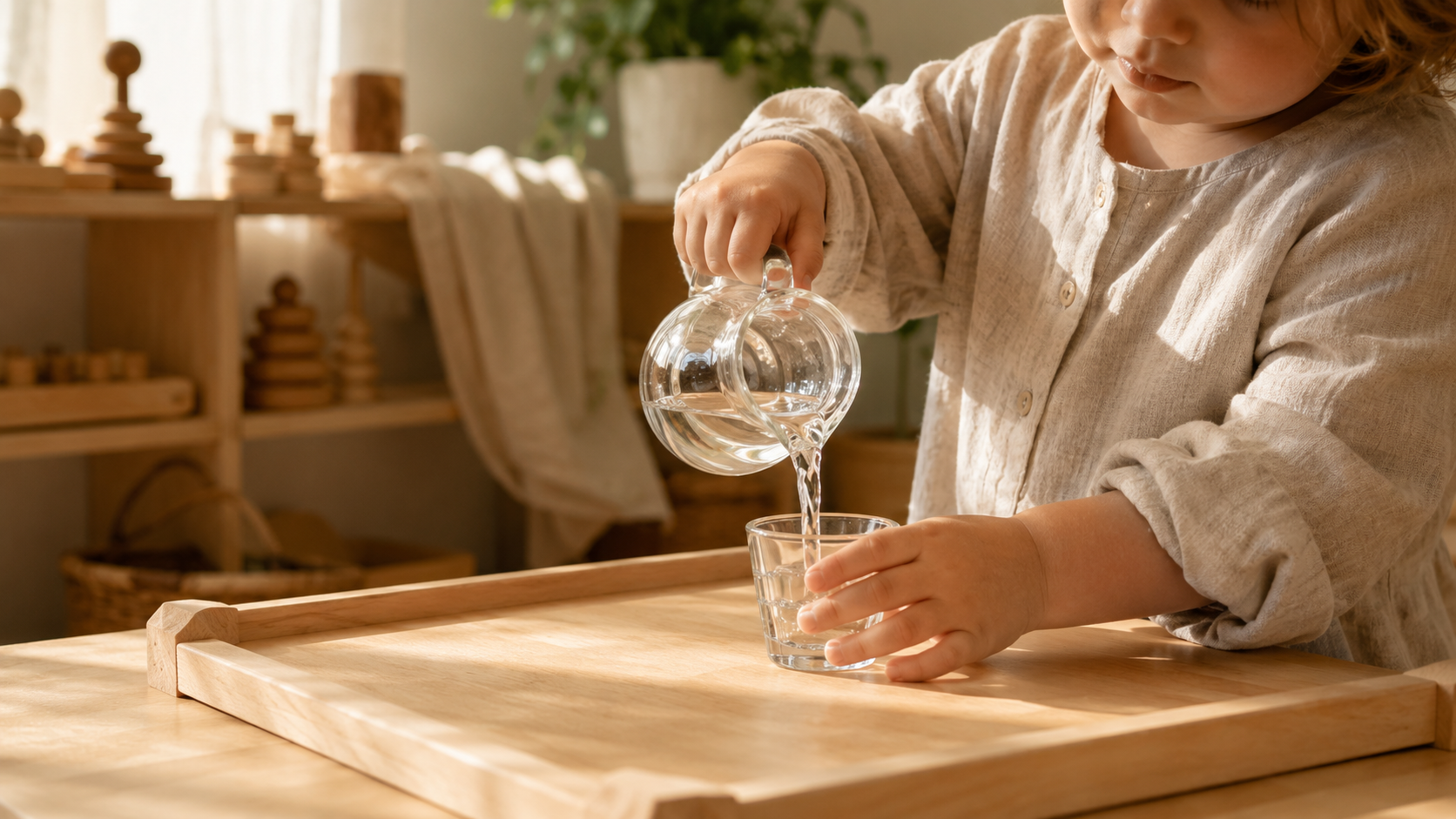
“Practical life” is the Montessori term commonly used for purposeful everyday activities such as pouring, washing, dressing, sweeping and preparing food.
Young children are often genuinely interested in this work because it is what they see the people around them doing. Their version will be slower and less precise, but the activity gives them an opportunity to practise coordination, sequencing and care for their surroundings.
Depending on age and readiness, a child might:
-
Carry napkins to the table.
-
Place fruit in a bowl.
-
Wash vegetables in a basin.
-
Stir ingredients with help.
-
Water a plant using a small container.
-
Match socks from the laundry.
-
Wipe a small spill.
-
Put books back on a shelf.
-
Brush their hair in front of a secure mirror.
Begin with one small part of a task. A toddler does not need to prepare an entire meal to participate meaningfully. Carrying two spoons to the table may be enough.
Expect spills, uneven results and repeated attempts. When time is short, it is also perfectly reasonable for the adult to complete the task. Montessori-inspired parenting does not require turning every weekday morning into a lesson.
Use child-sized tools carefully
A tool that fits smaller hands can make a task easier. This might be a lightweight brush, small jug, short-handled cleaning tool or appropriately sized chair.
However, “real” does not automatically mean suitable. Glassware, kitchen tools and breakable objects require judgement based on the child’s age, coordination and level of supervision.
Some families choose small open cups made from glass or ceramic. Others prefer durable child-safe materials. Either choice can support independent drinking. The important elements are appropriate sizing, careful demonstration and safe use—not allowing objects to break in order to teach a lesson.
Create an orderly play area
Children do not need access to every toy they own at the same time. A smaller visible selection can make it easier to choose an activity and return it when finished.
Try arranging materials so that:
-
Each activity has a clear place.
-
All required pieces are kept together.
-
Shelves are not overcrowded.
-
The child can see what is available.
-
Damaged or incomplete activities are removed.
-
Toys can be rotated without a complicated schedule.
A tray or shallow basket can help keep the pieces of one activity together. It also gives the child a visible beginning and end: take the activity to the table or floor, use it and return it to its place.
For practical room ideas, read our guide to creating a Montessori-inspired nursery.
Choose activities for the child you have now
A common mistake is choosing materials for the age or ability we hope a child will reach next. If an activity is too difficult, the adult ends up completing most of it. If it is far too easy, the child may lose interest quickly.
Look for the point at which your child can do much of the activity independently but still needs concentration and practice.
Good signs include:
-
Repeating the activity voluntarily.
-
Remaining engaged without constant entertainment.
-
Noticing and correcting some mistakes.
-
Trying a different approach after something does not work.
-
Returning to the material on another day.
Age recommendations remain important for safety, but children of the same age can have different interests and abilities. Observation is often more useful than buying everything described as suitable for a particular developmental stage.
Browse Montessori-inspired toys or use our guide to choosing a Montessori-inspired gift for more help matching an activity to the individual child.
Let the child attempt the difficult part
When a child struggles with a zip, puzzle piece or small spill, the fastest response is often to take over. Sometimes that is necessary. At other times, waiting for a few moments gives the child space to work out what to do.
Before stepping in, try:
-
Pausing to see whether the child continues.
-
Offering one short clue rather than the complete solution.
-
Demonstrating slowly and then returning the object.
-
Helping with only the part that is currently too difficult.
-
Asking, “Would you like help?”
This does not mean watching a child become increasingly distressed. The aim is a manageable challenge, not a test of endurance.
Show slowly and use fewer words
Young children often learn everyday tasks more easily by watching than by listening to a long explanation.
If you are demonstrating how to wipe a table, move slowly enough for the sequence to be visible: pick up the cloth, wipe one area, check the surface and return the cloth. Avoid explaining every movement at the same time.
Then allow the child to try. Their method may not look exactly like yours, and that is usually fine if the task remains safe.
Make room for concentration
Concentration cannot be demanded, but the environment can make it easier.
When your child becomes absorbed in a safe activity, avoid interrupting unnecessarily to correct the result, ask questions or suggest something “better”. Even positive commentary can break the thread of attention.
You do not need a silent home. Ordinary family noise is part of life. Simply notice when a child is deeply involved and protect that moment when possible.
Hands-on activities such as building, sorting, drawing and pretend play can all create opportunities for sustained attention. They do not need to carry a Montessori label. Our guide to open-ended toys explains how simple materials can support active, self-directed play.
Encourage participation without expecting perfection
A Montessori-inspired home is sometimes shown as permanently tidy, peaceful and filled with children who carefully return every object to its exact place.
Real family life is different.
Children spill water. They abandon activities halfway through. They may enthusiastically wipe a table today and refuse tomorrow. A two-year-old’s idea of folding laundry may create more work than it removes.
Participation matters more than a perfect result. Keep routines simple, model them consistently and adjust your expectations to the child’s age.
Montessori-inspired ideas by age
Babies
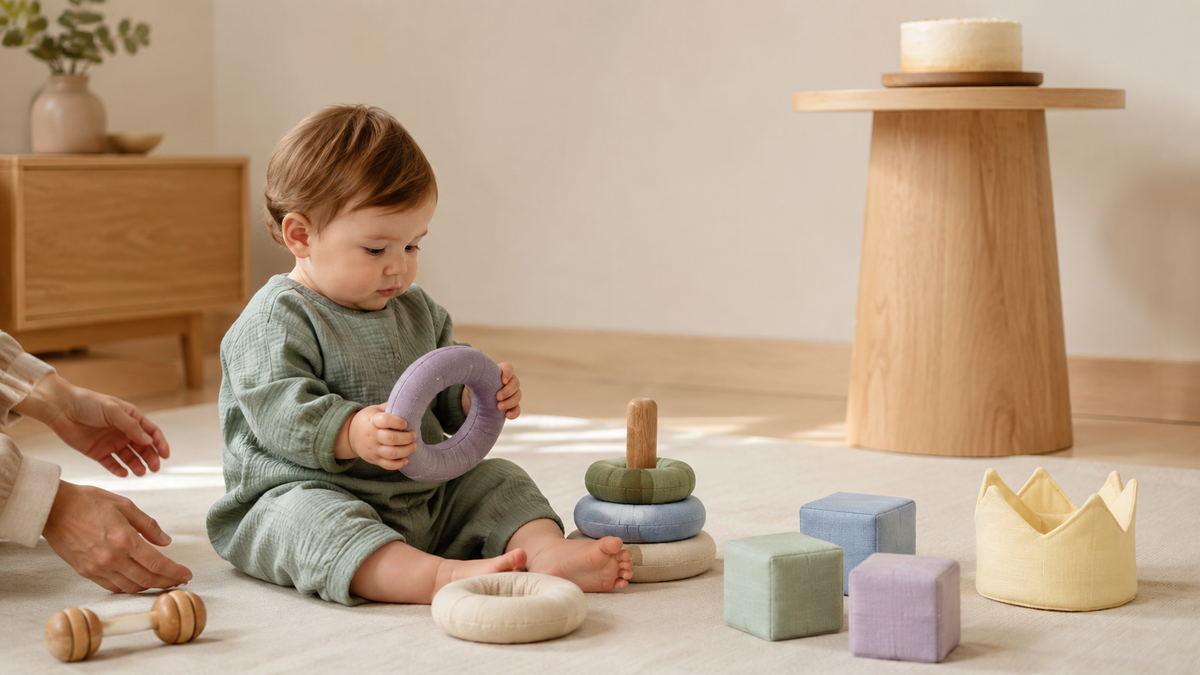
For babies, the focus is on safe movement, sensory exploration and connection with a responsive adult.
You might provide:
-
A safe area for supervised floor movement.
-
A simple mobile or visually engaging object positioned appropriately.
-
A small number of baby-safe grasping materials.
-
Space to reach, roll and explore without unnecessary equipment.
-
A secure mirror designed and installed for a baby’s environment.
Follow current safe-sleep guidance and choose every object according to the baby’s developmental stage.
Toddlers
Toddlers often want to imitate everyday work and do things “by myself”.
Suitable opportunities may include:
-
Carrying a small object to its place.
-
Placing clothes in a basket.
-
Washing hands with assistance.
-
Choosing between two outfits.
-
Pouring a small amount of water with supervision.
-
Returning one activity before choosing another.
Keep tasks short and expect repetition.
Preschoolers
Preschool children may be ready for longer sequences and greater responsibility.
They can often participate in:
-
Simple food preparation.
-
Setting part of the table.
-
Sorting laundry.
-
Caring for plants.
-
Organising art materials.
-
Using child-appropriate cleaning tools.
-
Completing puzzles and construction activities independently.
The exact task should still reflect the individual child’s abilities and the level of adult supervision available.
School-age children
The same principles continue beyond the early years. Older children can take greater responsibility for their belongings, participate in household routines and help design systems that work for them.
A reachable checklist, organised workspace or predictable place for school items can be more helpful than repeated reminders from an adult.
What you do not need for a Montessori-inspired home
You do not need:
-
An all-neutral interior.
-
A separate playroom.
-
Only wooden toys.
-
A large collection of specialist materials.
-
A perfectly tidy child.
-
Expensive furniture in every room.
-
To replace objects that already work well.
-
To follow every Montessori practice.
A home can support independence while still being colourful, busy and recognisably lived in. The most useful changes are often small and specific to one recurring family routine.
Start with one small change
Choose one moment of the day that currently requires repeated help. It might be putting on shoes, selecting a book, getting a drink or tidying art supplies.
Then ask what makes the task difficult. Is the object too high, too heavy, too complicated or surrounded by too many choices?
Change only that part and observe what happens.
Montessori at home is not a finished look. It is an ongoing practice of noticing what a child is ready to do and shaping the environment so they can take the next manageable step.
Explore Gravitaly’s Montessori-inspired toys, children’s furniture and storage solutions for thoughtful ways to support play, order and everyday participation at home.
GRAVITALY JOURNAL