


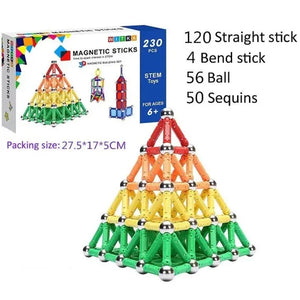


230-Piece Magnetic STEM Construction Set
- Builds Spatial & STEM Understanding
- Encourages Creativity & Open-Ended Building
- Develops Logic & Problem-Solving
- Strengthens Fine Motor & Hand-Eye Coordination
Free Shipping on Orders Over €45
Secure Payments
Easy 14-day Returns
2-year legal warranty
Description
Connect.
Build.
Balance.
Change the angle.
Take it apart.
Then build something completely different.
The 230-Piece Magnetic STEM Construction Set turns simple geometric components into an open-ended building system where children can experiment with shapes, structures and three-dimensional design.
Using colourful magnetic building elements, connecting spheres and geometric pieces, children can create everything from simple triangles and cubes to towers, bridges, geometric sculptures and imaginative structures of their own design.
There is no single finished model.
No one correct solution.
And no reason to build the same thing twice.
With 230 construction pieces available, the real question is:
What can you create next?
230 Pieces for Bigger Ideas
A larger construction set gives children room to move beyond small starter models.
Instead of stopping after one simple shape, they can keep building.
Make it taller.
Make it wider.
Add another level.
Connect two structures.
Reinforce the base.
Change the geometry.
With 230 pieces to work with, the building process can become much more ambitious.
Magnetic Connections Make Building Intuitive
The construction system uses magnetic connections to help the individual components come together.
Children can connect pieces from different directions and experiment with angles, shapes and structural arrangements.
The satisfying connection makes it easy to begin.
The challenge comes from deciding what to build.
From Flat Shapes to 3D Structures
Start with something simple.
A triangle.
A square.
A diamond.
Then begin connecting those shapes.
A flat design becomes a cube.
A cube becomes a tower.
A few triangles become the beginning of a pyramid.
The magnetic system helps children see how two-dimensional geometry can transform into three-dimensional construction.
STEM Learning You Can Hold
Geometry and engineering concepts are much easier to understand when children can physically manipulate them.
Instead of only looking at a cube in a book, they can build one.
Instead of being told that triangles can create strong structures, they can experiment with them.
Instead of imagining how several shapes fit together, they can test the idea themselves.
That is what makes magnetic construction such a useful STEM activity.
Why Children Love It
Magnetic construction gives children a fast reward.
Two pieces connect.
Then another.
And another.
Within moments, an idea starts taking shape.
Children can:
-
Build geometric figures
-
Create towers
-
Construct houses
-
Design bridges
-
Experiment with pyramids
-
Make abstract sculptures
-
Build symmetrical designs
-
Create imaginary machines
-
Copy model ideas
-
Invent completely original structures
-
Take everything apart
-
Start again
The set does not decide what the finished creation should look like.
The builder does.
Why Parents Love It
Open-ended construction play supports several developmental skills at the same time.
Children can practise:
-
Fine motor control
-
Hand-eye coordination
-
Spatial awareness
-
Logical thinking
-
Problem-solving
-
Creativity
-
Planning
-
Concentration
-
Symmetry
-
Shape recognition
-
Independent play
-
Cooperation
And because the pieces can be rebuilt again and again, the activity changes as the child's skills and ideas develop.
Build a Triangle
Three connected sides.
One simple shape.
But triangles are the foundation of many much larger structures.
Children can begin with basic geometry and then discover how several triangles combine to create three-dimensional forms.
Build a Square
Four sides create another familiar shape.
Now ask:
What happens if we build six squares and connect them?
A cube begins to appear.
Geometry becomes something children physically construct instead of simply memorise.
Build a Cube
A cube introduces a new idea.
Height.
Depth.
Volume.
A flat square becomes part of a three-dimensional object.
Building one by hand can help children understand the relationship between faces, edges and corners in a much more concrete way.
Build a Pyramid
Pyramids introduce triangles, symmetry and structural thinking.
How wide should the base be?
How do the sides meet?
What happens if one connection is placed incorrectly?
The model becomes a puzzle in engineering.
Build a Tower
Tall structures create a different challenge.
A tower needs enough support.
The lower levels matter.
Balance matters.
Symmetry can matter.
Children begin experimenting with stability without needing a formal engineering lesson.
Build a Bridge
Can the structure span a gap?
Where should the supports go?
How can it become stronger?
Bridge building encourages children to think about load, shape and structure through simple experimentation.
Build Something Nobody Has Named Yet
Not every construction needs to represent a real object.
Some of the most interesting creations begin with:
“What happens if I connect this here?”
Abstract building encourages children to follow curiosity rather than instructions.
The finished structure might be a spaceship.
A futuristic building.
A machine.
Or simply something that looks interesting.
Creativity Without Templates
Model cards and example structures can be useful.
But the greatest value of an open-ended construction set often comes after children stop copying.
The pieces become a vocabulary.
The child decides how to use them.
A familiar shape can become something completely new.
Explore Geometry Through Play
Magnetic construction naturally introduces geometric ideas such as:
-
Lines
-
Angles
-
Triangles
-
Squares
-
Polygons
-
Cubes
-
Pyramids
-
Symmetry
-
Three-dimensional forms
Children do not need to know all of those terms immediately.
Building comes first.
The vocabulary can follow.
Understand Angles
Connections can be explored from different directions.
Change the angle and the structure changes.
Children begin seeing that geometry is not simply a collection of names.
It affects how objects are actually built.
Discover Symmetry
Can both sides look the same?
Build one half.
Then try to reproduce it on the other.
Symmetry challenges children to observe carefully and compare positions.
Explore Balance
Large structures need planning.
If one side becomes too heavy or poorly supported, the model may change shape or collapse.
That is useful feedback.
Children can adjust the design and try again.
Engineering Through Trial & Error
Real engineering rarely works perfectly on the first attempt.
Neither does imaginative construction.
Build.
Test.
Notice a problem.
Strengthen the base.
Change a connection.
Try again.
That process is exactly where much of the learning happens.
Problem-Solving with a Physical Result
The problem is visible.
The solution is visible too.
A tower falls.
Why?
A shape will not close.
What needs changing?
The model feels unstable.
Where could another support go?
Children receive immediate feedback from the structure they are building.
Spatial Awareness
Building in three dimensions requires children to think beyond what they see directly in front of them.
Where will the next piece go?
What is behind the structure?
How high is it becoming?
Will these two sections meet?
That type of spatial thinking supports many later activities involving design, mathematics and engineering.
Fine Motor Skills
Construction involves repeated precise movements.
Pick up a component.
Rotate it.
Position it.
Align the magnetic connection.
Hold another part steady.
Add the next piece.
Those actions encourage controlled hand and finger movement throughout the activity.
Hand-Eye Coordination
Children need to visually identify where a component belongs and guide it into position.
The larger the model becomes, the more carefully they may need to work.
Two-Handed Coordination
Many builds require both hands.
One holds the existing structure.
The other adds a new component.
That cooperation between the hands supports bilateral coordination.
Planning Before Building
Some children will begin immediately.
Others may first decide what they want to create.
Both approaches are valuable.
Planning a model encourages children to think ahead:
What shape should the base be?
How many levels?
Which elements do I need?
Where will the structure finish?
Learn from Mistakes
Something will eventually fall apart.
That is not a failure.
It is information.
Maybe the base was too narrow.
Perhaps the angle was wrong.
Maybe another connector is needed.
Magnetic construction encourages children to modify rather than abandon an idea.
Concentration with a Purpose
Complex structures take time.
Children need to keep track of where components go and protect the parts already built while adding more.
The desire to complete the model provides a natural reason to stay focused.
Patience & Perseverance
One connection.
Then another.
Then another.
Larger builds require persistence.
The finished structure feels satisfying because it represents many small decisions and actions.
Build from an Example
Children can begin by reproducing a model they have seen.
Look at the structure.
Identify the shapes.
Work out how the pieces connect.
Copying a design is itself a useful spatial challenge.
Then Change the Design
Once the model is complete, ask:
Can it be taller?
Could we add another side?
Can we turn it into something else?
Changing an existing structure encourages flexible thinking.
Create Your Own Building Challenge
Try simple challenges:
Build the tallest tower you can.
Create a structure using only triangles.
Build something symmetrical.
Make a bridge between two objects.
Build a cube and turn it into something new.
Create a structure that stands on a small base.
One set can produce dozens of different challenges.
Make Mathematics Physical
Concepts like shape, symmetry, angle and dimension become easier to discuss when there is something tangible on the table.
Children can point.
Move pieces.
Compare.
Rebuild.
Mathematics becomes an activity rather than an abstract explanation.
STEM Through Open-Ended Play
The set naturally brings together several STEM areas.
Science
Experiment with magnetism, balance and physical relationships.
Technology
Explore how designed components create a reusable construction system.
Engineering
Build, test, reinforce and redesign structures.
Mathematics
Work with shapes, symmetry, spatial relationships and geometry.
One activity moves easily between all four.
Discover Magnetism
The connections also create an opportunity to introduce a basic scientific concept:
magnetic attraction.
Why do the components connect?
What happens when they approach one another?
Children can explore the physical behaviour before learning the scientific explanation in more detail.
Screen-Free Building
No tablet is required.
No digital construction game.
No app.
The child works directly with physical pieces in real space.
That makes every model something they can actually hold, rotate and examine from different angles.
Battery-Free Play
The set does not need electronics to create interaction.
The magnets provide the connection.
The child provides the ideas.
No charging.
No batteries.
No electronic programme deciding what happens next.
Independent Play
Magnetic construction works especially well as an independent activity.
Children can choose their own goal and work at their own pace.
There is no opponent.
No countdown.
No score.
Only the next piece.
Build Together
The large number of pieces also makes collaborative construction possible.
One child can build the base.
Another can work on the upper section.
Then the two parts can be connected.
Shared projects encourage communication and planning.
Parent & Child STEM Play
Adults can join without taking over.
Try questions such as:
“How could we make this stronger?”
“What shape should come next?”
“Can we make both sides the same?”
“What happens if we change this angle?”
“How tall can we make it?”
Questions help children think about the structure while still allowing them to make the decisions.
Sibling Play
A larger set can support several children working with the pieces together.
They can:
-
Build one shared model
-
Divide the pieces
-
Create separate structures
-
Compare designs
-
Connect their constructions
That makes the set suitable for both cooperative and parallel play.
From Simple to Complex
A beginner might make:
A triangle.
A square.
A simple cube.
Later, the same set can become:
A tower.
A bridge.
A geometric sculpture.
A complex multi-level structure.
The pieces do not become more complicated.
The builder does.
A Construction Set That Grows with Skill
That flexibility gives open-ended building toys a long useful life.
The challenge is not fixed by the toy.
It is created by the child.
As spatial understanding improves, the constructions can become increasingly ambitious.
Colour & Shape Recognition
The colourful components can also support younger builders in recognising:
-
Colours
-
Shapes
-
Repeating patterns
-
Symmetrical arrangements
Building challenges can easily incorporate these ideas.
Create Patterns
Red.
Blue.
Yellow.
Green.
Repeat.
Pattern-building adds another mathematical layer to the construction activity.
Build by Colour
Try making one side in one colour and another side in a different colour.
Or create a repeating colour sequence around a structure.
This encourages children to plan visually as well as structurally.
Perfect for Young Builders
The set is especially appealing for children interested in:
-
Construction
-
STEM
-
Engineering
-
Geometry
-
Magnets
-
Architecture
-
Puzzles
-
Creative building
-
3D design
-
How things fit together
The open format gives those interests plenty of room.
A Gift with Hundreds of Possibilities
A fixed model has a finishing point.
An open-ended magnetic construction set does not.
Today it becomes a tower.
Tomorrow a bridge.
Next week a futuristic city.
The same 230 pieces can be rearranged again and again.
Perfect For
-
STEM learning
-
Magnetic construction
-
2D shape building
-
3D construction
-
Geometry exploration
-
Engineering challenges
-
Spatial reasoning
-
Logical thinking
-
Fine motor activities
-
Hand-eye coordination
-
Problem-solving
-
Creative design
-
Independent play
-
Sibling play
-
Parent-and-child projects
-
Screen-free activities
Product Highlights
-
Magnetic STEM construction set
-
230 pieces
-
Open-ended building system
-
Magnetic connecting components
-
Connecting spheres
-
Colourful construction pieces
-
Geometric building elements
-
Supports 2D construction
-
Supports 3D construction
-
Build geometric shapes
-
Build towers and structures
-
Encourages creative design
-
Supports STEM learning
-
Develops spatial awareness
-
Encourages logical thinking
-
Supports problem-solving
-
Develops fine motor skills
-
Supports hand-eye coordination
-
Encourages patience and concentration
-
Suitable for independent or shared construction play
-
Battery-free
-
Screen-free
-
Rebuildable design
What Is Included
230 × Magnetic Construction Components
Assorted Magnetic Building Elements
Connecting Spheres
Assorted Geometric Construction Pieces
Start with One Connection
Two pieces become a line.
Three can become a triangle.
More pieces become a structure.
Then Keep Building
Add another level.
Change the shape.
Reinforce the base.
Take everything apart.
Start again.
With 230 magnetic construction pieces, the finished model is never really the end of the activity.
Connect, build and redesign — an open-ended magnetic STEM set for turning geometry, engineering and imagination into structures children can hold in their hands.
Specifications
Brand Story
Gravitaly: Kindheit, sorgfältig kuratiert
Gravitaly entstand aus einer einfachen Überzeugung: Familien sollten sich nicht durch endlose Produkte suchen müssen, um etwas zu finden, das es wirklich wert ist, in die Welt eines Kindes gebracht zu werden.
Wir definieren uns nicht über ein Material, ein Ursprungsland oder eine Spielweise. Gravitaly definiert sich über Kuration – den durchdachten Prozess, Produkte zu entdecken, die Zweck, Design und echten Mehrwert für den Familienalltag vereinen.
Unsere Kollektionen versammeln bewährte europäische Marken, unabhängige Macher und sorgfältig ausgewählte globale Hersteller. Jedes Produkt wird einzeln danach bewertet, was es bieten kann: fantasievolles Spiel, wachsende Unabhängigkeit, sensorische Entdeckung, praktische Unterstützung oder ein wenig mehr Schönheit und Komfort im Alltag eines Kindes.
Wir blicken über flüchtige Trends und überfüllte Kataloge hinaus. Stattdessen wählen wir Spielzeug, Baby-Essentials, Begleiter für den Schulalltag und Stücke für das Kinderzimmer aus, die relevant, nützlich und in der Welt von Gravitaly ganz natürlich zu Hause sind.
Einige Produkte ermutigen Kinder dazu, zu bauen, zu kreieren und ihre eigenen Geschichten zu erfinden. Andere machen den Eltern den Alltag leichter oder verwandeln eine gewöhnliche Ecke in einen Ort zum Lesen, Ausruhen und für die Fantasie. Was sie verbindet, ist nicht die Gleichheit, sondern die Absicht.
Unser Ansatz ist selektiv statt restriktiv. Wir schätzen Handwerkskunst, durchdachte Materialien und zeitloses Design, erkennen aber auch an, dass freudvolle Kindheitserlebnisse viele verschiedene Formen annehmen können. Produktdetails – einschließlich Materialien, Altersempfehlung, Herkunft und verfügbarer Zertifizierungen – werden einzeln präsentiert, damit Familien klare und selbstbewusste Entscheidungen treffen können.
Jede Gravitaly-Kollektion beginnt mit einer Frage:
Würden wir uns sicher dabei fühlen, dies für ein Kind auszuwählen, das wir lieben?
Das bedeutet „sorgfältig kuratiert“ für uns: weniger Ablenkungen, aussagekräftigere Auswahlen und Produkte, die ausgewählt wurden, um ein Teil der echten Kindheit zu werden – ihrer Spiele, Routinen, Zimmer, Abenteuer und Erinnerungen.
Frequently asked questions
230-Piece Magnetic STEM Construction Set
Recommended age

Development skills
Through play, this toy can help children develop these skills:


