


Montessori Wooden Growth Cycle Learning Game – 40 Discs & 10 Life Cycles
- Makes Growth & Life Cycles Easy to Understand
- Develops Sequencing, Logic & Problem-Solving
- Builds Early Science Knowledge & Vocabulary
- Supports Fine Motor Skills & Independent Montessori Learning
Free Shipping on Orders Over €45
Secure Payments
Easy 14-day Returns
2-year legal warranty
Description
A seed becomes a sprout.
An egg becomes a tiny new life.
A young plant grows taller.
A small creature changes, develops and eventually becomes an adult.
But what happens in between?
The Montessori Wooden Growth Cycle Learning Game turns the fascinating process of growth and transformation into a hands-on activity children can see, touch, arrange and understand.
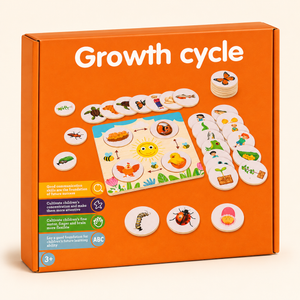
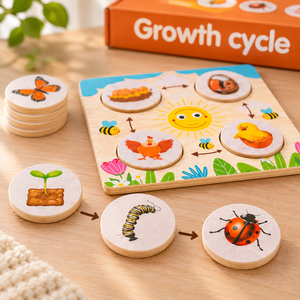
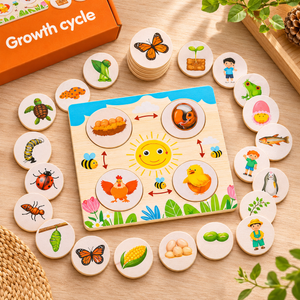
With 40 illustrated wooden discs, children can explore 10 different plant and animal life cycles, each represented through 4 sequential growth stages.
Choose one cycle.
Find its four matching pieces.
Look carefully at what changes.
Then place the stages in the correct order.
Beginning → Growth → Development → Mature stage
Instead of simply being told how living things grow, children build the sequence themselves.
Montessori Learning Through Real-Life Sequences
Young children understand abstract ideas more easily when they can work with something physical.
Growth happens slowly.
A seed does not become a plant in front of us in five minutes.
An egg does not immediately become an adult animal.
That can make life cycles difficult to visualise.
The Montessori Growth Cycle Game turns those long natural processes into clear illustrated stages children can physically arrange.
Pick up the pieces.
Compare them.
Look for clues.
Place them in order.
Check the sequence.
Try another.
The child becomes an active participant in discovering how living things change over time.
10 Different Growth Cycles to Discover
The set contains 10 complete growth and life cycles.
Each cycle is represented by 4 illustrated wooden discs.
That means children can explore ten different examples of growth while learning that plants and animals may develop in very different ways.
Some begin with seeds.
Others begin with eggs or another early stage.
Some change dramatically as they develop.
Others gradually grow larger and more recognisable.
Each new sequence asks the same fascinating question:
“What happens next?”
40 Illustrated Wooden Discs
The set includes:
40 illustrated wooden discs
organised into:
10 life cycles × 4 developmental stages
The circular pieces are designed for hands-on matching and sequencing.
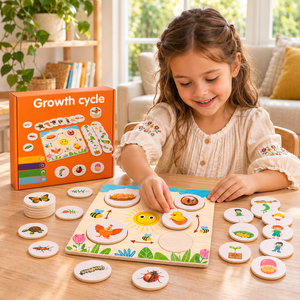
Children can pick them up, compare images, move them around and correct their own arrangements.
That makes the learning experience tactile rather than purely visual.
Follow Growth from Beginning to End
Every cycle tells a small story.
Something begins.
It changes.
It grows.
Eventually, it reaches a more developed stage.
Children learn to recognise that living things do not simply appear fully formed.
Development happens through a sequence.
What Comes First?
One of the first challenges is recognising the beginning of the cycle.
A seed?
An egg?
A young organism?
Children look closely at the illustrations and decide where the story starts.
What Happens Next?
Once the first piece is identified, the reasoning begins.
Which image shows the next stage?
Which looks more developed?
Which must come before the mature form?
Children compare visual information and use logic to construct the sequence.
And What Comes Last?
The final stage completes the cycle.
A mature plant.
An adult organism.
A fully developed form.
Seeing all four pieces together allows children to understand the complete transformation at a glance.
Why Children Love It
There is a puzzle hidden inside every growth cycle.
Four pieces.
One correct sequence.
Children can:
-
Match related images
-
Build life cycles
-
Put growth stages in order
-
Compare young and mature forms
-
Discover how plants develop
-
Discover how animals change
-
Rebuild familiar sequences from memory
-
Create guessing games
-
Ask questions about nature
-
Play independently
-
Learn alongside an adult
The activity feels like solving a visual mystery rather than memorising a science lesson.
Why Parents Love It
The Montessori Growth Cycle Game combines early science with important developmental skills.
Children practise:
-
Sequencing
-
Logical thinking
-
Observation
-
Visual discrimination
-
Problem-solving
-
Memory
-
Concentration
-
Fine motor skills
-
Hand-eye coordination
-
Language and communication
-
Classification
-
Independent learning
And because everything is physical and battery-free, the child remains actively involved in the learning process.
From Seed to Plant
Plant growth is one of the clearest examples of change over time.
A tiny seed may eventually become something completely different in size, shape and colour.
Growth-cycle play allows children to compare those stages side by side.
The transformation becomes easier to understand because every stage has a visible place in the sequence.
From Egg to Adult
Animal development can be just as fascinating.
Some animals begin life looking very different from their adult form.
Others develop more gradually.
By arranging illustrated stages, children can begin to recognise these patterns.
Discover Metamorphosis
Some life cycles involve dramatic transformation.
The organism at one stage may look almost nothing like the final adult.
That creates wonderful questions:
“Is this really the same animal?”
“How does it change?”
“What happens between these two pictures?”
The pieces become a starting point for scientific curiosity.
Learn That Growth Takes Time
Children often understand time through familiar routines:
Morning.
Lunch.
Bedtime.
Tomorrow.
Life cycles introduce a much larger idea.
Living things change over days, weeks, months or even years.
The game provides a simple visual foundation for understanding that growth is a process.
Beginning, Middle & End
Life-cycle sequencing also connects naturally with storytelling.
Every cycle has:
A beginning.
Development in the middle.
A later stage.
Children can describe what they see just as they would describe events in a story.
That connection supports both science and language development.
Practise Sequencing
Sequencing is one of the strongest skills in this activity.
Children need to decide:
First
Next
Then
Last
These concepts appear everywhere in childhood learning:
-
Stories
-
Daily routines
-
Mathematics
-
Instructions
-
Science
-
Problem-solving
A growth cycle provides a meaningful natural sequence to practise with.
Build Logical Thinking
The pieces cannot simply be arranged randomly.
The order needs to make sense.
A mature plant cannot come before the seed.
A final developmental stage cannot appear at the beginning.
Children use visual evidence and prior knowledge to decide what belongs where.
Encourage Observation
Look closely.
What changed?
Did the organism become larger?
Did a new feature appear?
Are there leaves now?
Has the body shape changed?
Observation turns simple picture matching into scientific thinking.
Compare the Stages
Placing four related images together encourages children to notice similarities and differences.
What stayed the same?
What changed completely?
Which two stages look most similar?
Which transformation is the biggest?
Comparison helps children develop visual discrimination and analytical thinking.
Learn Through Self-Correction
A child may place two stages in the wrong order.
That is useful.
Instead of immediately correcting them, ask:
“Does this look like it comes before or after this one?”
Children can reconsider the images and adjust the sequence themselves.
The goal is not simply to produce the answer.
The goal is to understand why the order makes sense.
Montessori-Inspired Discovery
The activity fits naturally into Montessori-inspired learning because it uses:
-
Physical materials
-
Clear visual relationships
-
Independent exploration
-
Repetition
-
Sequencing
-
Observation
-
Self-correction
Children can work at their own pace instead of being pushed through a fixed electronic programme.
Concrete Before Abstract
“Life cycle” is an abstract scientific concept.
Four pictures are concrete.
That distinction matters.
Children first manipulate the visible stages.
Later, adults can introduce vocabulary such as:
Life cycle.
Growth.
Development.
Mature.
Adult.
Seed.
Egg.
Metamorphosis.
The physical experience gives those words meaning.
Build Early Science Vocabulary
As children become more confident, introduce useful words and phrases:
Life cycle
Growth cycle
Stage
Development
Seed
Sprout
Young
Adult
Mature
Growth
Change
Transformation
Learning vocabulary becomes easier when the word describes something directly in front of the child.
Ask “What Changed?”
This may be the most useful question in the entire activity.
Compare two stages.
What changed?
Size?
Colour?
Shape?
Body parts?
Leaves?
Children begin learning to describe observations rather than simply name pictures.
Ask “What Happens Next?”
Hide one stage.
Can the child predict what comes next?
This transforms the activity from matching into reasoning.
Ask “What Came Before?”
Reverse the challenge.
Show the mature stage.
What might it have looked like earlier?
Thinking backwards strengthens understanding of the whole sequence.
Mix the Pieces
Once children know several cycles, mix discs from different groups together.
Now the challenge becomes harder.
First identify which four belong together.
Then arrange them in sequence.
Two cognitive tasks become one.
Match the Families
Before worrying about order, children can simply group related stages.
Which four pictures belong to the same living thing?
That introduces classification and visual association.
Then Put Them in Order
Once the correct group has been found, sequencing begins.
This creates a natural progression from easier to more challenging play.
Play from Memory
After completing a life cycle several times, remove the reference.
Can the child rebuild it without help?
Memory becomes part of the activity.
Create a Missing-Stage Game
Arrange three of the four stages.
Leave one missing.
Ask:
“What is missing?”
Then let the child search among the remaining wooden discs.
Which Comes First?
Place two related discs side by side.
Ask which comes earlier.
This simpler version works well before attempting the entire four-stage sequence.
Which Comes Last?
Now identify the final stage.
Children learn that sequences have direction.
Tell the Story of Growth
Encourage children to describe the process aloud.
For example:
“First…”
“Then…”
“After that…”
“Finally…”
This combines sequencing with language and storytelling.
Build Communication Skills
The game naturally creates opportunities to talk.
Adults can ask:
“What do you notice?”
“Which one should come next?”
“Why did you choose that?”
“What changed?”
“Do you think this is the beginning or the end?”
Open questions encourage children to explain their thinking.
Fine Motor Skills
Every disc needs to be:
Picked up.
Rotated.
Compared.
Positioned.
Moved.
Rearranged.
Those repeated movements support fine motor coordination during a meaningful learning activity.
Hand-Eye Coordination
Children visually identify where a piece belongs and guide it into position.
That repeated connection between looking and moving supports hand-eye coordination.
Concentration
Completing one four-stage sequence requires sustained attention.
The child must identify related images, compare developmental stages and remember the direction of the sequence.
The task gives concentration a clear purpose.
Memory & Recall
Repeated play allows children to begin remembering familiar growth cycles.
They may eventually know the correct sequence before placing a single disc.
That visible progress can create a strong sense of mastery.
Problem-Solving
Sometimes the answer is obvious.
Sometimes two stages look very similar.
Children need to use clues.
Look at size.
Look at development.
Look at new features.
Then decide.
Nature Becomes a Puzzle
Young children are naturally curious about living things.
This set turns that curiosity into something they can physically investigate.
The question is no longer simply:
“What is this?”
It becomes:
“How did it become this?”
Understand Change in Nature
Growth cycles introduce an important idea:
Living things change.
Plants develop.
Animals grow.
Some organisms transform dramatically.
Nature is constantly moving from one stage to another.
Science Without a Screen
No video is required.
No tablet.
No app.
No animation.
Children recreate the transformation themselves using physical wooden pieces.
That makes them participants rather than viewers.
Battery-Free Learning
There are no electronic components.
No charging.
No batteries.
No automatic answers.
The activity depends entirely on observation, thinking and interaction.
Child-Led Learning
Children can choose which life cycle they want to build first.
They can repeat a favourite.
Skip one that feels difficult.
Return to it later.
Mix several groups together.
The material supports independent exploration.
Perfect for a Montessori Shelf
The simple wooden format works beautifully in a Montessori-inspired learning area.
Present the board with a selected set of four discs for a focused activity.
Once the sequence becomes familiar, introduce another.
Later, several cycles can be offered at the same time.
The difficulty grows with the child.
Start with One Cycle
For younger or first-time players, do not present all 40 discs immediately.
Choose four.
Explore them together.
Identify what they show.
Arrange the stages.
That creates a clear, achievable first activity.
Add Another Cycle
Once the concept is understood, introduce another set.
Now children can compare two completely different ways of growing.
Eventually Mix All 40 Pieces
For confident players, all 40 discs can become a larger classification and sequencing challenge.
Find the groups.
Build the ten cycles.
Check the order.
That dramatically increases the cognitive challenge without changing the toy.
A Toy That Grows with Understanding
At first, the child may simply match pictures.
Later, they sequence stages.
Then they begin explaining why the sequence works.
Eventually, adults can use the same materials to discuss:
-
Plant development
-
Animal development
-
Metamorphosis
-
Reproduction
-
Habitats
-
Seasons
-
Growth
-
Biological change
The pieces stay the same.
The conversation becomes more sophisticated.
Home Learning
The Growth Cycle Game is especially useful for home activities about:
-
Nature
-
Biology
-
Plants
-
Animals
-
Science
-
Sequencing
-
Classification
There is no need for a formal lesson plan.
Choose one cycle and begin with curiosity.
Preschool & Early Science Learning
The clear visual stages make the activity suitable for introductory science learning.
Children can work independently or alongside an adult.
The focus can change depending on the child's level:
First recognise.
Then match.
Then sequence.
Then explain.
Nature Walk Follow-Up
The activity can even extend beyond the table.
See a plant outside?
Look for seeds.
Notice young leaves.
Find insects.
Talk about what they may have looked like earlier in their development.
The wooden pieces can help connect indoor learning with observations in the real world.
Perfect for Curious Children
This Montessori Growth Cycle Game is especially suited to children interested in:
-
Animals
-
Plants
-
Nature
-
Science
-
Puzzles
-
Matching
-
Sequencing
-
“Why?” questions
-
How things change
It gives curiosity a physical activity to work with.
Wooden Hands-On Learning
The set uses wooden components rather than disposable cards or electronic pieces.
The discs have a satisfying physical presence and can be picked up and rearranged repeatedly.
Compact Learning Activity
The matching Growth Cycle version measures approximately:
17 × 15.5 cm
making it compact enough for a table, learning shelf or activity area.
It does not require a large setup.
Product Highlights
-
Montessori wooden Growth Cycle Learning Game
-
Growth and life-cycle sequencing activity
-
40 illustrated wooden discs
-
10 different growth/life cycles
-
4 stages per life cycle
-
1 wooden activity board
-
Plant and animal growth concepts
-
Introduces life cycles
-
Introduces developmental stages
-
Encourages sequencing
-
Supports logical thinking
-
Encourages observation
-
Develops visual discrimination
-
Encourages classification
-
Supports memory and concentration
-
Develops problem-solving
-
Encourages language and communication
-
Supports fine motor skills
-
Supports hand-eye coordination
-
Encourages independent Montessori learning
-
Battery-free
-
Screen-free
-
Wooden construction
-
Approx. size: 17 × 15.5 cm
What Is Included
1 × Wooden Montessori Growth Cycle Activity Board
40 × Illustrated Wooden Growth Cycle Discs
10 × Complete Life Cycles
4 × Growth Stages per Life Cycle
Find the Beginning
Which image shows where the story starts?
Follow the Change
What happens next?
And after that?
Complete the Cycle
Four images.
One sequence.
One small story about how life grows and changes.
Match, sequence and discover — a Montessori wooden science activity that turns growth and life cycles into something children can see, touch and understand.
Specifications
Brand Story
Gravitaly: Gyerekkor, gondosan válogatva
A Gravitaly egy egyszerű meggyőződésből született: a családoknak nem kellene végtelen termékpalettát átkutatniuk, hogy találjanak valamit, ami valóban érdemes arra, hogy bekerüljön egy gyermek világába.
Nem egy anyag, egy származási ország vagy egy játékstílus határoz meg minket. A Gravitalyt a kurátori szemlélet határozza meg – az a gondos folyamat, amely során olyan termékeket fedezünk fel, amelyek ötvözik a célt, a dizájnt és a valódi értéket a mindennapi családi élethez.
Kollekcióink megbízható európai márkákat, független készítőket és gondosan válogatott globális gyártókat hoznak össze. Minden terméket egyedileg mérlegelünk aszerint, mit nyújthat: ötletes játékot, növekvő önállóságot, érzékszervi felfedezést, gyakorlati támogatást, vagy egy kis plusz szépséget és kényelmet a gyermek mindennapjaiban.
Túltekintünk a múló trendeken és a túlzsúfolt katalógusokon. Ehelyett olyan játékokat, babaholmi-alapdarabokat, iskolai társakat és gyerekszobai darabokat választunk, amelyek relevánsnak, hasznosnak és természetesen otthonosnak érződnek a Gravitaly világában.
Egyes termékek építésre, alkotásra és saját történetek kitalálására ösztönzik a gyerekeket. Mások megkönnyítik a szülők napi rutinját, vagy átalakítják az átlagos sarkokat olvasásra, pihenésre és képzeletbeli játékra alkalmas hellyé. Ami összeköti őket, az nem az egyformaság, hanem a szándék.
Megközelítésünk szelektív, nem korlátozó. Nagyra értékeljük a kézművességet, az átgondolt anyagokat és az időtálló dizájnt, miközben elismerjük, hogy az örömteli gyermekkori élmények sokféle formát ölthetnek. A termék részletei – beleértve az anyagokat, az ajánlott életkort, a származást és a rendelkezésre álló tanúsítványokat – külön-külön kerülnek bemutatásra, lehetővé téve a családok számára a világos és magabiztos választást.
Minden Gravitaly kollekció egyetlen kérdéssel kezdődik:
Magabiztosan választanánk ezt egy gyermeknek, akit szeretünk?
Számunkra a gondos válogatás ezt jelenti: kevesebb figyelemelterelés, több értelmes választási lehetőség és olyan termékek, amelyeket arra választottunk, hogy a valódi gyerekkor részévé váljanak – a játékaihoz, rutinjaihoz, szobáihoz, kalandjaihoz és emlékeihez.
Frequently asked questions
Montessori Wooden Growth Cycle Learning Game – 40 Discs & 10 Life Cycles

Development skills
Through play, this toy can help children develop these skills:


