


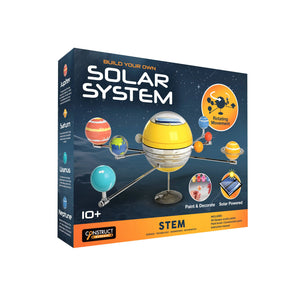
Build & Paint Your Own Solar System – Solar-Powered 3D STEM Model
- Brings the Solar System to Life
- Introduces Solar Energy Through a Working Experiment
- Combines STEM Learning with Creativity
- Develops Focus & Hands-On Skills
Free Shipping on Orders Over €45
Secure Payments
Easy 14-day Returns
2-year legal warranty
Description
Build the Sun.
Assemble the planets.
Paint every world.
Then place the finished model in the light and watch the Solar System begin to move.
The Build & Paint Your Own Solar System STEM Kit combines astronomy, construction, art and renewable energy in one hands-on project for curious young space explorers.
Children assemble a three-dimensional model featuring the Sun and all eight planets, decorate the celestial bodies using the included acrylic paints and then discover the most exciting part:
The finished planetary system actually moves.
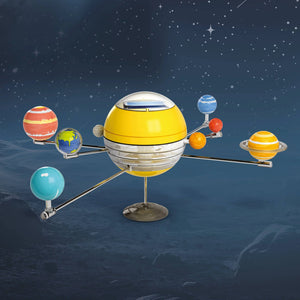
A solar panel positioned on top of the Sun captures light and powers the rotating mechanism, allowing the planets to orbit around the centre without batteries.
It is part science project.
Part creative activity.
Part working model of our cosmic neighbourhood.
Build the Solar System Yourself
The experience begins before anything starts moving.
The individual parts need to become a complete planetary model.
Children assemble the central Sun, connect the orbital structure and position each planet around it.
Piece by piece, something that began as separate plastic components starts to resemble the Solar System they have seen in books, classrooms and science videos.
But this time, they built it themselves.
Meet All Eight Planets
The model includes all eight planets of our Solar System:
-
Mercury
-
Venus
-
Earth
-
Mars
-
Jupiter
-
Saturn
-
Uranus
-
Neptune
Each one becomes part of the finished three-dimensional display surrounding the central Sun.
The construction creates a physical reference point for learning the names and order of the planets.
Start with the Sun
At the centre of the model sits the Sun on its supporting pedestal.
It does more than complete the visual design.
The top of the Sun holds the solar panel that powers the movement of the planetary system.
That means the centre of the model also becomes the centre of its energy system.
Light reaches the panel.
The mechanism receives power.
And the planets begin to move.
Paint the Planets Yourself
The planets do not need to stay exactly as they arrive in the box.
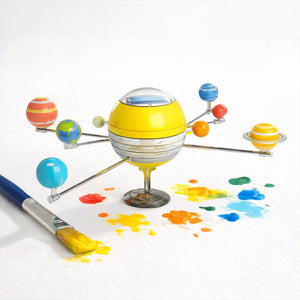
The kit includes six opaque acrylic paints and a paintbrush, turning construction into a creative project too.
Children can study how the planets usually appear and try to recreate them.
Or they can experiment with colour and create their own interpretation.
Jupiter's bands.
Earth's blue oceans.
Mars in red and orange.
Saturn and its famous rings.
Painting encourages children to stop and look more carefully at the differences between the planets.
Six Acrylic Colours Included
The set comes with:
6 × Acrylic Paints
and
1 × Paintbrush
so the creative part of the project can begin without needing a separate paint set.
Colours can be used individually or experimented with to create different shades and details across the planetary models.
Why Children Love It
There are several satisfying moments built into one project.
First, the pieces become a model.
Then the blank planets become colourful.
Then the completed Solar System starts moving.
Children can:
-
Assemble the planetary model
-
Paint all eight planets
-
Learn their names
-
Discover their order from the Sun
-
Observe planetary movement
-
Explore solar energy
-
Create a display for a bedroom or desk
-
Use the finished model during astronomy learning
-
Compare different planets
-
Ask questions about space
-
Revisit the model after the construction activity is complete
The project does not disappear once the building is finished.
It becomes something children can keep looking at and learning from.
Why Parents Love It
The kit brings several different kinds of learning into one activity.
Children work with their hands.
Follow an assembly process.
Use a paintbrush.
Think about colour and appearance.
Recognise planetary names and positions.
Observe movement.
And discover that light can provide the energy needed to power a mechanism.
The activity naturally combines:
-
Astronomy
-
STEM learning
-
Renewable energy
-
Fine motor skills
-
Hand-eye coordination
-
Creativity
-
Construction
-
Observation
-
Problem-solving
-
Concentration
All around one subject children tend to find naturally fascinating:
space.
Astronomy Becomes Something You Can Hold
The Solar System is enormous.
Almost unimaginably enormous.
That makes it difficult to experience directly.
A physical model makes the idea more approachable.
Children can point to Earth.
Find Mars.
Compare the relative visual appearance of Jupiter and Mercury.
Trace the sequence from the inner planets towards Neptune.
The model gives abstract astronomical names a physical place.
Learn the Order of the Planets
One of the first steps in understanding our Solar System is discovering where the planets sit in relation to the Sun.
Starting closest to the Sun:
Mercury
Venus
Earth
Mars
Jupiter
Saturn
Uranus
Neptune
The assembled model provides a visual reminder children can return to repeatedly.
Find Earth
Among eight different planets, one is particularly familiar.
Earth.
Finding our own planet inside the larger model creates an immediate connection between everyday life and the much larger Solar System.
From there, new questions often follow naturally.
What comes before Earth?
What comes after it?
Which planet is largest?
Which one has rings?
How far away is Neptune?
A model can become the starting point for a lot of curiosity.
Build First, Learn While You Go
STEM activities often work best when children have something concrete to achieve.
Here, the goal is obvious.
Build the model.
That means learning does not need to begin with a worksheet.
It begins with pieces in the hands.
As children construct the system, astronomy and mechanics gradually become part of the activity.
STEM Learning Through Construction
The project connects several STEM ideas.
Science
Explore planets, the Solar System, light and solar energy.
Technology
Observe a solar panel powering a working mechanism.
Engineering
Assemble individual parts into a functioning moving structure.
Mathematics & Logic
Follow sequences, positions and relationships between components.
The finished model brings those areas together in one physical project.
Powered by Light
One of the most distinctive features is the solar-powered movement.
The model does not rely on disposable batteries for operation.
Instead, a small solar panel sits at the top of the central Sun.
Expose it to a strong suitable light source and the generated energy powers the mechanism that moves the planets around the centre.
No Batteries Required
There is no battery compartment to keep filling with replacement batteries.
The movement is powered through the included solar panel.
That turns the energy source into part of the educational experience itself.
Children do not only see the planets move.
They can investigate why they are moving.
Discover Solar Energy in Action
Solar energy can sound abstract when it is only described.
This model makes the principle visible.
Light reaches the solar panel.
The panel converts available light into electrical energy.
The motorised mechanism uses that energy.
The planets move.
That simple sequence creates a hands-on introduction to renewable energy.
What Happens When the Light Changes?
Once the model is assembled, it can become a small experiment.
Try placing the panel in strong light.
Observe the movement.
Change its position.
Change the angle.
Compare what happens under weaker conditions.
The model creates an opportunity to investigate the relationship between light and the energy available to the mechanism.
Strong Light Gives the Best Result
Because the movement depends on solar energy, the model performs best when the panel receives a strong direct light source.
Ordinary low indoor lighting may not always provide enough energy to drive the mechanism effectively.
That is not a flaw in the experiment.
It is part of understanding how solar power works.
From Light to Motion
The model demonstrates a simple but powerful chain of events:
Light → Solar Panel → Energy → Mechanical Movement
Children can actually observe the final result.
The planets begin to orbit.
That makes energy conversion easier to understand than when it exists only as a diagram in a textbook.
Watch the Planets Orbit
Once powered, the model creates rotating orbital movement around the central Sun.
The movement transforms the finished project from a static display into an interactive astronomy model.
Children can watch the different planetary arms travel around the centre and observe the overall structure of the system from different angles.
A Moving Model Is More Memorable
A poster can show the planets.
A book can describe their orbits.
A moving three-dimensional model adds another layer.
Children can see that the planets are not simply objects arranged in a straight line.
They are part of a dynamic planetary system centred around the Sun.
Build, Paint, Then Observe
The activity has three distinct stages.
Build
Assemble the structure.
Create
Paint and decorate the planets.
Discover
Use light to power the completed model and observe it in motion.
That progression keeps the project varied from beginning to end.
Art Meets Astronomy
Science and creativity do not need to live in separate boxes.
Painting the planets brings both together.
Children might begin by looking at photographs of Jupiter.
Notice Mars is different from Earth.
Look at Saturn's rings.
Compare Uranus and Neptune.
Then translate those observations into colour.
Art becomes another way of looking closely at science.
Look More Closely at Every Planet
Painting creates a reason to observe.
What colour is Mars?
Why does Earth appear blue?
What makes Jupiter visually distinctive?
Which planets have visible rings?
How different are the outer planets from the inner ones?
Even if the final model is creative rather than scientifically exact, those questions can naturally emerge during the activity.
Make It Your Own
Children do not have to reproduce reference images perfectly.
This is also a making project.
They can use the six paints to experiment with:
-
Colour combinations
-
Patterns
-
Planetary details
-
Light and dark areas
-
Decorative interpretations
The same kit can result in a model that looks completely individual.
Develop Fine Motor Skills
Construction and painting both require controlled hand movements.
Children need to:
-
Handle smaller components
-
Align pieces
-
Connect structural parts
-
Hold the planets while decorating
-
Control the paintbrush
-
Add smaller painted details
The activity gives fine motor practice a clear creative purpose.
Hand-Eye Coordination
The eyes identify where a part needs to go.
The hands position it.
During painting, the same coordination guides the brush across the curved planetary surfaces.
The finished project requires repeated interaction between visual information and controlled movement.
Follow the Assembly Process
A three-dimensional model needs to come together in the correct sequence.
Children follow the supplied instructions, identify components and gradually build the complete structure.
This supports:
-
Sequencing
-
Concentration
-
Visual matching
-
Logical thinking
-
Independent problem-solving
The reward for careful assembly is a working model.
Problem-Solving Has a Purpose
If a piece does not fit, something needs checking.
If the structure does not move as expected, the construction and lighting conditions can be reviewed.
That gives problem-solving a physical result.
The goal is not to answer a question on paper.
It is to make the Solar System work.
Patience Becomes Part of the Project
Building.
Painting.
Allowing painted details to dry.
Completing the assembly.
Testing the solar mechanism.
This is a project that rewards taking time.
The finished model feels more meaningful because it was created through several stages rather than simply removed from a box already complete.
A Screen-Free Space Project
No app is needed.
No tablet.
No digital game.
No batteries.
Children work with physical pieces, paints, a brush and a solar-powered mechanism.
The result is technology play without turning the experience into more screen time.
Build Together
The model works well as a parent-and-child project too.
One person can organise the components.
Another follows the instructions.
Paint colours can be discussed together.
Planet names can be practised during assembly.
Then everyone gets to watch the finished model start moving.
Ask Questions While You Build
Try questions such as:
“Which planet is closest to the Sun?”
“Where does Earth go?”
“Which planet is the biggest?”
“Which one has the most recognisable rings?”
“What do you think makes the planets move?”
“What happens if the solar panel receives less light?”
The model provides a physical reference point for every conversation.
Create a Space Research Project
Older children can use the finished model as the centre of a wider astronomy activity.
Choose one planet.
Research it.
Find out:
-
How far it is from the Sun
-
How long its year lasts
-
What its atmosphere is like
-
Whether it has moons
-
How large it is
-
What makes it unusual
Then move to the next planet.
The construction kit becomes the starting point rather than the entire lesson.
Inner Planets & Outer Planets
Once children know the basic order, the model can help introduce another idea.
The four inner planets:
-
Mercury
-
Venus
-
Earth
-
Mars
And the four outer planets:
-
Jupiter
-
Saturn
-
Uranus
-
Neptune
The physical arrangement helps give those categories context.
Rocky Worlds & Giant Planets
The model can also inspire conversations about how different planets are from one another.
Earth and Mars are rocky worlds.
Jupiter is enormously different.
Saturn has its spectacular rings.
Uranus and Neptune belong to another part of the planetary family.
One small model can lead to a surprisingly large number of science questions.
Our Place in Space
Perhaps the most interesting lesson is also the simplest.
Earth is one planet.
Orbiting one star.
Inside a much larger universe.
Finding our small blue world among the other planets can help children begin thinking about scale, space and our place within it.
A Display Worth Keeping
Once the assembly and painting are finished, the model does not need to disappear back into the box.
It can become a colourful educational display for:
-
A bedroom
-
Study desk
-
Bookshelf
-
Classroom
-
Science corner
The creator gets to keep something that shows both what they learned and what they made.
A Great Gift for Space Fans
The project is particularly well suited to children who already ask questions about:
-
Planets
-
Space
-
Rockets
-
Astronomy
-
Science
-
Solar energy
-
How things work
It gives that curiosity something physical to work with.
Designed for Ages 10+
The recommended age for the kit is 10 years and above.
The combination of assembly, smaller components, painting and the working solar mechanism makes it particularly suitable for older children ready for a more detailed hands-on STEM project.
Adult supervision is recommended, particularly during initial construction and painting.
More Than a Planet Model
At first glance, it is a model of the Solar System.
But the activity also introduces:
Construction.
Painting.
Astronomy.
Energy.
Mechanics.
Observation.
Problem-solving.
That combination is what makes the project more interesting than a static planetary display.
Product Highlights
-
Build & Paint Your Own Solar System STEM Kit
-
Construct & Create product range
-
Product code: 129229
-
EAN: 5056327923695
-
3D Solar System construction model
-
Central Sun
-
All 8 planets included
-
Moving orbital mechanism
-
Solar-powered movement
-
Solar panel positioned above the Sun
-
No batteries required
-
Assemble the model yourself
-
Paint and decorate the planets
-
6 opaque acrylic paints included
-
Paintbrush included
-
Construction parts included
-
Step-by-step instructions included
-
Plastic construction
-
Multicoloured finished model
-
Introduces astronomy
-
Introduces solar energy
-
Encourages STEM learning
-
Supports fine motor skills
-
Encourages hand-eye coordination
-
Encourages problem-solving
-
Supports concentration and sequencing
-
Combines science and creativity
-
Screen-free activity
-
Recommended age: 10+
-
CE marking
What Is Included
1 × Solar System Construction Set
1 × Central Sun & Support Stand
8 × Planet Models to Assemble
1 × Integrated Solar Panel
6 × Opaque Acrylic Paints
1 × Paintbrush
Construction Components
Assembly Instructions
Start with Separate Pieces
At the beginning, there is no Solar System.
Only components.
A brush.
Colours.
Planet parts.
And an idea of what the finished project might become.
Then the building begins.
Finish with a Moving Universe
Assemble the planets.
Paint every world.
Position the finished model in strong light.
Then watch the system come alive.
The planets begin to move around the Sun using energy captured directly from light.
A craft project becomes a science model.
A science model becomes an experiment.
And a handful of components becomes a small moving universe built by the child holding it.
Build it, paint it and power it with light — then watch your own Solar System begin to move.
Specifications
Frequently asked questions
Build & Paint Your Own Solar System – Solar-Powered 3D STEM Model
Recommended age

Development skills
Through play, this toy can help children develop these skills:


