


Build Your Own Tobbie Self-Guiding Robot – Interactive STEM Kit
- Build a Real Working Robot
- Explore Infrared Sensor Technology
- Develops Engineering & Problem-Solving Skills
- Learning Continues After the Build
Free Shipping on Orders Over €45
Secure Payments
Easy 14-day Returns
2-year legal warranty
Description
First, Tobbie is a box full of components.
Gears.
Body panels.
Screws.
Sensors.
A motor.
An electronic board.
Then comes the interesting part.
You build him.
Piece by piece, the mechanical parts begin to connect. Six legs take shape. The yellow body comes together. The electronics find their place.
Add the batteries, switch him on — and the robot you assembled yourself starts walking.
The Tobbie Self-Guiding Robot STEM Kit combines hands-on construction with interactive robotics, giving young makers the experience of building a functioning robot before exploring how sensors help it react to the world around it.
Once assembled, Tobbie has two interactive modes.
In Follow Me mode, he detects a nearby person, hand or object and follows it.
Switch to Explore mode and his infrared sensors help him detect obstacles and find another way around.
Building is only the first half of the project.
What happens after Tobbie comes to life is where robotics really begins.
Build the Robot Yourself
Tobbie does not arrive ready to play.
That is very much the point.
The kit contains more than 100 mechanical and electronic components that need to be identified, positioned and assembled step by step.
Children work through the construction process to create a complete six-legged walking robot.
The finished result feels different from a ready-made electronic toy because the builder has already discovered some of what is happening beneath the yellow shell.
From Components to a Working Robot
At first, individual gears and plastic sections may not look like much.
Then the connections begin to make sense.
A gear becomes part of the movement system.
A leg connects to the walking mechanism.
The motor becomes part of the drive.
The infrared sensors become Tobbie's way of detecting what is happening around him.
The construction process reveals how separate mechanical and electronic systems can work together inside one functioning machine.
Approximately 2.5 Hours of Building
The complete build is designed as a substantial STEM project rather than a five-minute assembly.
Allow approximately 2.5 hours for construction.
Some builders may finish faster.
Others may prefer to work through the project slowly, checking each stage before continuing.
Basic tools are required for assembly.
For younger builders, adult assistance may be useful during more detailed stages.
Why Children Love It
Building Tobbie leads to a very clear reward.
He moves.
He reacts.
His eyes light up.
He makes sounds.
And the child knows that none of that happened until the individual components were assembled correctly.
Once construction is finished, children can:
-
Make Tobbie follow them
-
Watch him explore independently
-
Create obstacle courses
-
Experiment with sensor detection
-
Test different object positions
-
Observe how he changes direction
-
Learn how his six-legged walking mechanism moves
-
Create navigation challenges
-
Experiment with light and sensor conditions
-
Play with the finished robot they built themselves
The project begins as construction and ends as interactive robotics.
Why Parents Love It
Tobbie gives STEM concepts a physical context.
Instead of only reading about gears, motors and sensors, children work with them.
They need to follow a sequence.
Recognise components.
Align mechanical parts.
Connect sections correctly.
Troubleshoot if something does not move as expected.
Then observe how the finished robot uses sensor input to change its behaviour.
The result combines:
-
Engineering
-
Robotics
-
Mechanics
-
Electronics
-
Logical sequencing
-
Fine motor skills
-
Spatial awareness
-
Problem-solving
-
Patience
-
Cause and effect
And all of it leads towards one very tangible goal:
making the robot work.
Meet Tobbie
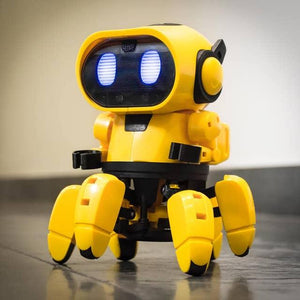
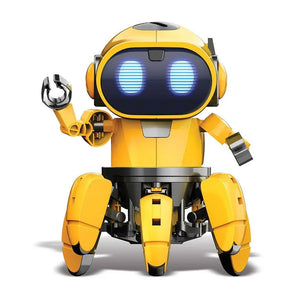
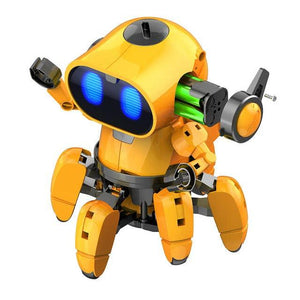
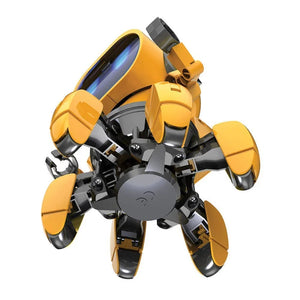
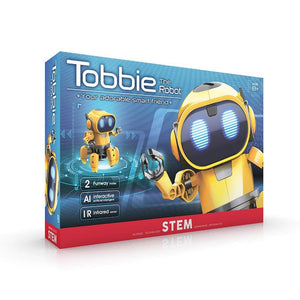
Tobbie is a compact yellow six-legged robot with glowing blue LED-style eyes and a surprisingly expressive personality.
He looks friendly rather than industrial.
But underneath that character design is a genuine mechanical construction project.
His body contains the systems responsible for movement, sensing and interaction.
That combination is what makes him interesting.
He is both a character to play with and a machine to investigate.
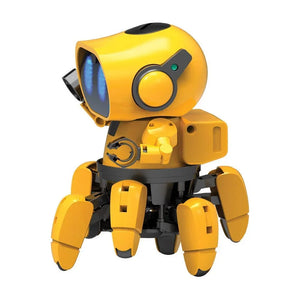
Six Legs Instead of Wheels
Tobbie does not roll around like a conventional robot car.
He walks.
His six-leg mechanism gives him his distinctive movement and allows children to observe mechanical motion in a much more visible way.
As the motor drives the internal mechanism, the legs work together to move the robot across a suitable flat surface.
Watching that happen becomes its own small engineering lesson.
See Mechanics in Motion
A wheel is easy to understand.
Turn the wheel and the vehicle moves.
Walking mechanics are more complex.
Several moving parts need to work in sequence for Tobbie's legs to produce stable forward movement.
Because the robot is built rather than delivered as a sealed finished toy, children encounter those components during construction.
Once Tobbie begins walking, the movement suddenly makes much more sense.
Two Interactive Modes
Tobbie has two main operating modes:
Follow Me
and
Explore
Each uses his infrared sensing system in a different way.
That means children are not simply turning the robot on and watching the same behaviour repeatedly.
Changing mode changes what Tobbie is trying to do.
Follow Me Mode
Switch Tobbie into Follow Me mode and he becomes a little robotic companion.
His sensors look for an object, hand or person in front of him.
Move.
Tobbie responds.
Change position.
He adjusts.
The robot uses sensor input to determine where the object is and attempts to follow it.
This creates a wonderfully simple demonstration of how a machine can use information from its environment to decide what to do next.
Can Tobbie Follow You?
Start close.
Let the robot detect you.
Then move slowly.
Can Tobbie keep following?
Try moving your hand instead.
Change direction.
Change the distance.
Move towards one side.
Each small experiment gives children another opportunity to observe how the robot responds to sensor input.
Explore Mode
Switch to Explore mode and Tobbie becomes independent.
Instead of looking for something to follow, he moves through the environment while using his infrared sensors to detect obstacles.
When something appears in his path, the robot responds and changes direction.
He does not need a pre-built track.
He investigates the space himself.
Build an Obstacle Course
A clear floor is only the beginning.
Create a safe course using suitable household objects.
Place one obstacle ahead.
Then another.
Create a route.
Switch Tobbie to Explore mode.
And watch.
Will he detect the obstacle?
Which direction will he choose?
Will he find another way through?
Changing the layout creates a new experiment without changing the robot.
How Does Tobbie See?
Not with eyes in the human sense.
Tobbie uses infrared sensors to detect nearby objects.
The system sends and receives infrared information that helps the robot recognise when something is in front of him.
That input then influences his movement.
The concept is simple enough to observe directly:
Object detected.
Robot reacts.
An Introduction to Sensors
Sensors are everywhere in modern technology.
Automatic doors.
Robots.
Vehicles.
Phones.
Smart-home devices.
Industrial machinery.
Tobbie gives children a small, approachable example of the same basic principle.
A sensor gathers information.
The machine responds to that information.
Children can see this relationship happening physically in front of them.
Input → Decision → Movement
Much of robotics can be understood through a simple sequence.
Input
The infrared sensor detects something.
Decision
The robot's electronic system processes that information.
Movement
Tobbie follows, stops, turns or chooses another direction.
The internal system is obviously more complex than those three words, but the visible behaviour makes the principle easy to grasp.
STEM Learning You Can Actually Touch
The kit combines several areas of STEM in one project.
Science
Experiment with infrared sensing and cause and effect.
Technology
Work with an electronic board, sensors and motorised systems.
Engineering
Assemble mechanical components and create a functioning walking structure.
Mathematics & Logic
Follow sequences, identify relationships between parts and reason through construction problems.
None of those areas need to be presented as a formal lesson.
They are built into the activity.
Mechanical Engineering in Miniature
During construction, children work with components such as:
-
Gears
-
Linkages
-
Motor parts
-
Fasteners
-
Body structures
-
Walking mechanisms
Those elements provide a simple introduction to the idea that movement can be transferred from one mechanical component to another.
Once the motor runs, the pieces no longer exist independently.
They work as one system.
Electronics Meet Mechanics
A robot needs more than mechanical movement.
It also needs something to control that movement.
Tobbie combines the walking mechanism with:
-
An electronic control board
-
Infrared sensors
-
A motor
-
LED eyes
-
Sound feedback
-
Battery power
Construction brings those different systems together.
Follow the Sequence
Building a robot rewards patience.
Stage one needs to happen before stage two.
A component installed incorrectly can affect something later in the build.
That makes following the instructions carefully part of the challenge.
Children practise:
Reading ahead.
Identifying parts.
Checking orientation.
Completing steps in sequence.
Reviewing their work.
Then continuing.
Attention to Detail Matters
Mechanical construction can be wonderfully unforgiving.
A gear may need to face a particular direction.
A linkage needs to connect to the correct point.
A screw must hold the intended components together.
That encourages builders to look closely instead of rushing through the project.
The finished robot gives immediate feedback on whether all that attention worked.
What If Tobbie Doesn't Move Correctly?
Then the project becomes even more educational.
Go back.
Check the assembly.
Look at the moving parts.
Compare the construction with the instructions.
Is something misaligned?
Does a component need repositioning?
Troubleshooting is not a failure of the activity.
In engineering, troubleshooting is part of the activity.
Problem-Solving with a Real Outcome
Many puzzle toys tell the child when an answer is correct.
Tobbie does something even clearer.
He works.
Or something needs checking.
That makes problem-solving purposeful.
The goal is not simply to find an abstract answer.
The goal is to bring the robot to life.
Patience Pays Off
A project that takes a couple of hours creates a different kind of satisfaction from a toy that works immediately after opening the box.
There is anticipation.
First the body.
Then the legs.
Then the internal mechanism.
Then the electronics.
Eventually comes the moment when the batteries are installed and the switch is turned on.
That payoff belongs to the builder.
LED Eyes Bring Tobbie to Life
Once powered, Tobbie's distinctive blue LED eyes light up.
The illuminated face helps transform a collection of mechanical components into a character.
The lights also form part of the robot's feedback during operation.
Sound Effects Add Personality
Tobbie also uses sound feedback during operation.
Together with the glowing eyes and unusual walking movement, the sounds make the finished robot feel more like an interactive character than a simple mechanical model.
One-Button Mode Control
Once constructed, operation is deliberately straightforward.
The robot uses simple mode control rather than requiring a phone, app or complex programming interface.
Switch between the interactive behaviours and start experimenting.
The focus stays on the robot itself.
No App Required
Tobbie does not rely on a smartphone for his core functionality.
No app is needed to make him follow or explore.
His sensors and electronics are built directly into the robot.
That makes experimentation immediate once construction and battery installation are complete.
Create Experiments
Try changing one variable at a time.
Move an obstacle closer.
Then further away.
Approach from another direction.
Change the route.
Put Tobbie in Follow Me mode.
Then run the same setup in Explore mode.
What changes?
Simple experiments help children move from merely watching the robot towards actively investigating its behaviour.
Compare the Two Modes
The same sensor system creates very different behaviour depending on the selected mode.
In one mode, an object is something Tobbie wants to follow.
In the other, an object becomes something he needs to avoid.
That contrast is a useful introduction to an important idea in computing and robotics:
The same input can lead to different outputs depending on the instructions controlling the machine.
Learn Through Observation
Children do not need to understand every electronic component before they can begin asking useful questions.
Why did Tobbie turn there?
Why did he stop?
Why does he follow my hand?
What happens if I move faster?
What happens if the obstacle moves?
Curiosity is enough to begin.
Create a Robotics Challenge
Once the basic modes are familiar, invent challenges.
Try:
-
Follow a hand across the room
-
Navigate around three obstacles
-
Create a simple maze
-
Guide Tobbie towards a target
-
Test which objects he detects most easily
-
Compare Follow Me and Explore behaviour
-
Design a new obstacle course
-
Predict which direction he will turn
-
Time a navigation challenge
-
Rebuild the course and try again
The finished robot becomes a platform for repeated experimentation.
Smooth Surfaces Work Best
Tobbie's six-legged walking mechanism performs best on a smooth, relatively flat surface.
That allows the legs to move consistently and keeps attention on the sensor behaviour rather than surface resistance.
Very soft or uneven surfaces may affect how easily the robot moves.
Infrared Sensors & Lighting Conditions
Infrared sensing can be affected by environmental conditions.
For the clearest sensor performance, use Tobbie indoors and avoid very strong direct sunlight or intense halogen lighting aimed at the robot.
This gives the infrared system better conditions in which to detect nearby objects.
Powered by 4 × AAA Batteries
Tobbie requires:
4 × AAA batteries
Batteries are not included.
Once installed, the battery power allows Tobbie to move without being connected to a cable during operation.
That means obstacle courses and Follow Me experiments can take place freely across the play area.
Compact Once Built
The finished Tobbie measures approximately:
16 × 13 × 12 cm
That makes him large enough for the mechanical movement and LED face to be clearly visible while remaining compact enough for a desk, shelf or play table after the experiment is finished.
Approximately 335 g
The listed product weight is approximately:
335 g
The compact size makes Tobbie easy to reposition between experiments and straightforward to store when not in use.
ABS, PP & Metal Components
The construction uses a combination of:
-
ABS plastic
-
Polypropylene (PP)
-
Steel / metal fasteners and mechanical components
Different materials serve different roles within the finished structure.
The plastic forms the body and many mechanical components, while metal screws and springs help hold and operate parts of the mechanism.
A Robot You Know from the Inside Out
Most electronic toys hide everything interesting behind a sealed case.
Tobbie starts the other way around.
Before the shell is complete, the builder has already seen:
The gears.
The motor.
The connections.
The mechanical structure.
The sensor system.
That makes the finished robot more understandable because its internal construction is no longer completely mysterious.
Construction First, Play Second
Tobbie works especially well for children who enjoy the process as much as the result.
If the goal is simply to switch on a robot immediately, a ready-made robot does that faster.
Here, the build is a major part of the experience.
The reward is knowing exactly how much work happened before those blue eyes finally light up.
Designed for Young Makers
The product is suitable for children from approximately 8 years, with adult assistance useful during more detailed assembly stages.
Older children and adults who enjoy robotics kits can also find the mechanical construction interesting.
The activity rewards patience more than speed.
More Than a One-Time Build
Completing the construction is a milestone, not the end.
Once Tobbie works, children can continue using him for:
-
Sensor experiments
-
Obstacle courses
-
Follow-the-leader games
-
Robotics demonstrations
-
Navigation challenges
-
STEM discussions
-
Cause-and-effect experiments
The finished robot becomes the next stage of the project.
A Great First Step into Robotics
Tobbie does not require previous programming experience.
There is no expectation that children already understand electronics or mechanical engineering.
Instead, the kit introduces ideas through physical interaction.
Build the mechanism.
See it move.
Observe the sensor.
Change the environment.
Watch the response.
That makes robotics feel considerably less abstract.
Perfect For
-
Robotics beginners
-
Young engineers
-
STEM learning
-
Mechanical construction
-
Sensor experiments
-
Science projects
-
Technology enthusiasts
-
Problem-solving
-
Fine motor practice
-
Spatial thinking
-
Cause-and-effect learning
-
Patient builders
-
Parent-and-child projects
-
Screen-free STEM activities
-
Birthday gifts
-
Christmas gifts
Product Highlights
-
Tobbie self-guiding interactive robot
-
DIY STEM construction kit
-
Model 71511
-
EAN 5060512150513
-
More than 100 assembly components
-
Build the functioning robot yourself
-
Six-legged walking mechanism
-
Infrared sensor technology
-
Follow Me mode
-
Explore obstacle-avoidance mode
-
LED illuminated eyes
-
Sound feedback
-
One-button mode control
-
Motorised movement
-
Electronic control board
-
Gears and mechanical linkages
-
Encourages robotics learning
-
Encourages engineering exploration
-
Supports problem-solving
-
Supports sequencing and observation
-
Develops fine motor skills
-
Encourages spatial awareness
-
Approx. 2.5-hour construction project
-
Basic tools required for assembly
-
ABS plastic components
-
Polypropylene components
-
Steel / metal screws and springs
-
Approx. assembled dimensions: 16 × 13 × 12 cm
-
Approx. weight: 335 g
-
Requires 4 × AAA batteries
-
Batteries not included
-
Recommended from approximately 8 years
-
Yellow robot design
What Is Included
Tobbie Robot Plastic Body Components
Electronic Board with Infrared Sensors
Motor & Gearbox Components
Mechanical Gears & Linkages
Six-Leg Walking Components
Battery Holder
Metal Screws, Springs & Fasteners
Stickers / Decorative Elements
Step-by-Step Assembly Instructions
First You Build Him
There is no shortcut.
The gears need to connect.
The legs need to move.
The body needs to come together.
The electronics need to find their place.
That is exactly what makes the moment when Tobbie finally moves so satisfying.
Then Tobbie Starts Thinking for Himself
Switch to Follow Me and he looks for something to follow.
Switch to Explore and he begins finding his own way around obstacles.
The parts that were sitting on the table a couple of hours earlier are suddenly working together as one machine.
Build the mechanics, discover the sensors and bring your own walking robot to life — then see where Tobbie decides to go next.
Specifications
Frequently asked questions
Build Your Own Tobbie Self-Guiding Robot – Interactive STEM Kit
Recommended age

Development skills
Through play, this toy can help children develop these skills:


