Montessori-inspired toys do not teach empathy, patience or teamwork by themselves. What they can do is create useful opportunities for children to practise these abilities through real interactions: waiting for a piece, explaining an idea, coping with a fallen tower or finding a way to play alongside someone else.
The most important ingredient is not whether a toy is wooden, neutral-coloured or labelled “educational”. It is what the child is invited to do—and how adults support the moments of cooperation, frustration and discovery that follow.
The quick answer: How can toys support social and emotional skills?
Well-chosen play materials can give children opportunities to practise:
-
Taking turns and waiting.
-
Sharing space and materials.
-
Expressing an idea.
-
Listening to another person.
-
Negotiating different plans.
-
Recognising feelings.
-
Coping with frustration.
-
Asking for help.
-
Solving a shared problem.
-
Recovering when something does not work.
These skills develop gradually through relationships and repeated experience. A toy provides the situation; children and caregivers create the learning within it.
What are social and emotional skills?
Social skills help children interact with other people. They include communicating, cooperating, listening, entering a game, understanding boundaries and resolving everyday disagreements.
Emotional skills involve noticing feelings, expressing them safely and recovering from disappointment, excitement or frustration. They also include beginning to understand that another person may feel or think differently.
For young children, these abilities are still developing. A toddler who grabs a block is not necessarily being deliberately unkind. They may not yet have the language, impulse control or understanding needed to wait.
Play gives children a relatively safe place to encounter these challenges again and again.
What makes a toy Montessori-inspired?
The word “Montessori” is used very broadly in product descriptions. Not every wooden puzzle or beige stacking toy is an authentic Montessori classroom material.
At home, a toy may be described more accurately as Montessori-inspired when it encourages qualities such as:
-
Hands-on participation.
-
Purposeful movement.
-
Concentration and repetition.
-
A clear, manageable challenge.
-
Independent exploration.
-
Order and a visible sequence.
-
Learning through direct experience.
Some activities have one defined solution, such as fitting shapes into matching spaces. Others can be used in many ways, such as blocks and flexible construction pieces. Both types can be valuable.
Explore Montessori-inspired toys selected for hands-on play, problem-solving and independent discovery.
Independent play also matters
An article about social development can easily create the impression that children should always play together. They do not need to.
Independent play gives a child space to follow an idea, repeat an activity and work through manageable frustration without negotiating with another person. These experiences can support confidence and self-regulation, which later influence social interactions.
Parallel play—when children play beside one another without building one shared game—is also a normal and valuable stage. Two toddlers may use blocks near each other while paying close attention to what the other is doing.
Cooperation develops gradually. It should not be forced before children are ready.
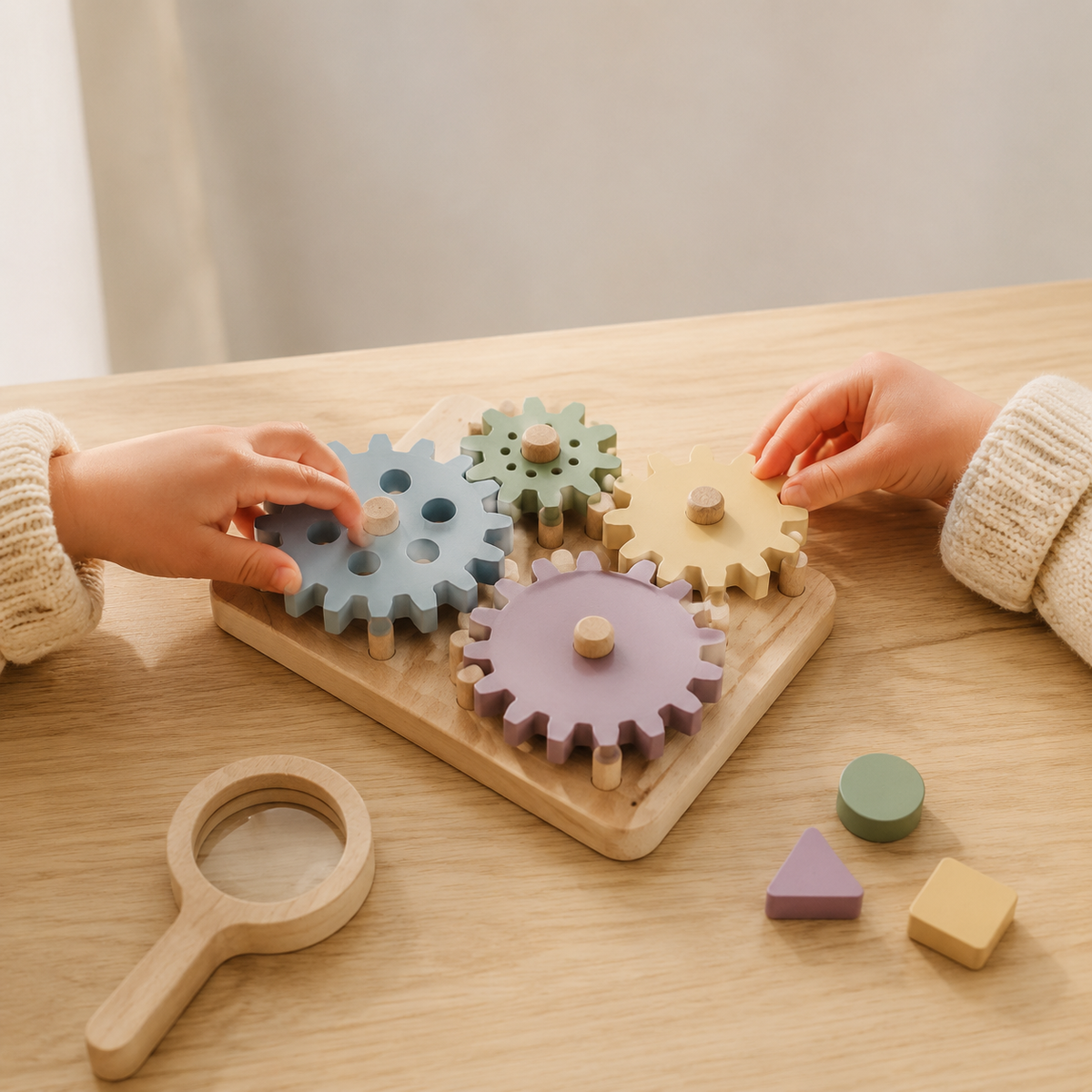
Sorting and matching: learning to share a workspace
Sorting and matching activities usually have a clear purpose. Children may organise pieces by colour, size, shape or category.
When two children use the same activity, they may need to decide:
-
Who chooses the next piece?
-
Where should each group go?
-
What happens if they disagree?
-
Can one child sort while the other checks?
-
How will they know when they are finished?
The adult can support the interaction without controlling every move.
Instead of immediately saying, “You must share,” try describing the situation:
“You both want the blue piece.”
Then offer language the children can use:
“Can I have it when you are finished?”
For very young children, duplicate materials or separate turns may be more realistic than expecting sustained cooperation.
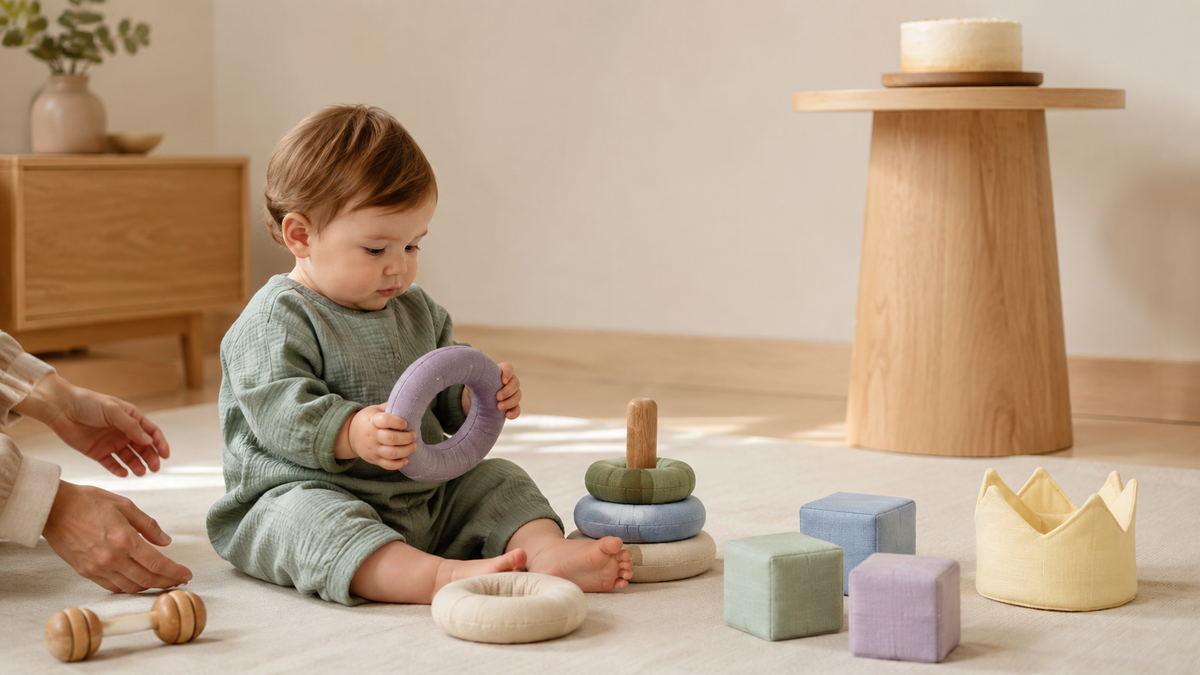
Stacking and balancing: practising frustration and flexibility
A tower falls. A balancing piece will not stay in place. Someone adds a block in exactly the spot another child wanted to use.
These moments can become small opportunities to practise emotional flexibility.
The aim is not to prevent every collapse or immediately rebuild the structure for the child. Pause briefly and observe. The child may try again, change the base or ask for help.
Useful responses include:
-
“That did not work the way you expected.”
-
“You look frustrated.”
-
“Would you like to try again or take a break?”
-
“What could make the bottom steadier?”
-
“Do you want help with one part?”
Naming the experience can help children connect a feeling with appropriate words. It does not guarantee that the frustration will disappear—and it does not need to.
The Modern X Montessori-Inspired Stacking Toy uses geometric pieces that can be arranged and balanced in different ways, leaving room for experimentation rather than one permanent finished result.
Building toys: negotiating a shared plan
Blocks and construction pieces are especially useful for collaborative play because they can support more than one idea.
One child may want to build a house. Another may be certain that the structure is a train station. Cooperation begins when they decide whether to combine the ideas, divide the materials or work separately.
Children may practise:
-
Explaining what they want to make.
-
Listening to another proposal.
-
Assigning roles.
-
Combining two ideas.
-
Changing a plan when pieces run out.
-
Repairing something that has been knocked down.
-
Deciding when the project is complete.
Adults do not need to turn the game into a teamwork lesson. Allow the play to remain enjoyable. Step in when children need help staying safe or communicating, not simply because their collaboration looks untidy.
Explore wooden toys and building materials for stacking, arranging and open-ended construction.
Puzzles and logic toys: cooperating around a problem
A puzzle offers a shared objective, but cooperation can take several forms.
Children might search for pieces together, take responsibility for different areas or explain why they think something fits. An older child may demonstrate a strategy to a younger sibling.
However, an older child taking every piece and completing the puzzle quickly is not meaningful collaboration. If one participant dominates, try giving each child a defined but flexible role:
-
One finds edge pieces.
-
One looks for a particular colour.
-
One turns pieces the correct way up.
-
Both alternate placing pieces.
Keep the role appropriate to each child’s ability. The goal is participation, not perfectly equal performance.
The Classic Wooden Puzzle Blocks – Long and Short can be compared, arranged and incorporated into different kinds of construction play.
Pretend play: exploring feelings and viewpoints
Pretend play is not always associated with formal Montessori classroom materials, but it can be especially rich in social and emotional practice at home.
When children care for a doll, run an imaginary café or build a home for toy animals, they experiment with roles and relationships. A character can be tired, nervous, excited, left out or in need of help.
Adults can occasionally extend the play with an open question:
-
“How do you think the bear feels?”
-
“What could help the doll feel welcome?”
-
“They both want to be the driver. What could happen next?”
-
“Who could help solve the problem?”
Avoid turning every story into an interview. One thoughtful question is often enough, and sometimes the best support is simply allowing the children to continue.
Practical-life activities: contributing to the group
Social development does not happen only through toys. Everyday tasks help children experience themselves as useful members of the family or classroom.
A child might:
-
Carry napkins to the table.
-
Water plants with another child.
-
Sort clean socks.
-
Help prepare a snack.
-
Wipe the table after an activity.
-
Return shared materials to a shelf.
-
Hold a container while someone else pours.
These tasks have a real purpose. The child’s contribution affects another person, which can make cooperation more concrete than being told to “work as a team”.
For more practical ideas, read our guide to using the Montessori method at home.
Does the material of the toy make a difference?
Wood, metal, fabric, silicone and high-quality plastics can all provide useful play experiences. Different materials offer different weights, temperatures, sounds and textures.
Natural wood can feel warm and substantial, and durable wooden toys may remain useful for years. But wood does not automatically make a toy calming, sustainable, educational or safe.
Similarly, a plastic toy is not automatically overstimulating or developmentally unhelpful. Design, sound, colour, complexity and the way the toy is used matter more than the material alone.
Always check:
-
The manufacturer’s age recommendation.
-
Small-parts and choking warnings.
-
Materials and finishes.
-
Care instructions.
-
Whether supervision is required.
-
The condition of the toy before play.
Safety comes before any educational claim.
How adults can support cooperative play
Observe before intervening
Not every disagreement requires immediate adult control. If the children are safe, pause long enough to see whether they attempt a solution.
Step in when the situation is escalating, one child is overwhelmed or someone’s boundaries are not being respected.
Describe what is happening
Neutral descriptions are often more helpful than blame:
“You were building with that piece, and now Leo has picked it up.”
This gives both children a clearer picture of the problem.
Provide useful language
Young children may know what they want but not how to say it.
Offer short phrases such as:
-
“Can I use it next?”
-
“I’m still playing with that.”
-
“Would you like to build with me?”
-
“I need some space.”
-
“Can we make a plan?”
The adult can model the words without requiring the child to repeat them perfectly.
Accept separate play as a solution
Children do not always need to agree on one shared project. Two baskets of blocks or separate building spaces may resolve the conflict more appropriately.
Choosing to play apart is not a social failure.
Avoid solving the entire problem
If adults decide who gets every piece, what everyone should build and how the finished result should look, children have little room to practise negotiation.
Offer only the support needed to help the interaction move forward.
Playing with siblings of different ages
Age gaps can create wonderful play, but they can also produce unrealistic expectations.
An older child should not always be required to teach, share every possession or include a younger sibling in a complex project. Younger children also need activities they can use safely without being corrected constantly.
To make shared play easier:
-
Choose materials safe for the youngest participant.
-
Remove pieces that present a choking hazard.
-
Provide enough basic pieces to reduce unnecessary competition.
-
Give each child space for an individual idea.
-
Allow the older child to keep some special projects separate.
-
Supervise according to the needs of the youngest child.
Mixed-age play can create opportunities for modelling and cooperation, but peaceful mentorship is not guaranteed—and sibling disagreement is not evidence that the toy has failed.
How to choose a toy for social play
Before buying, ask:
Can more than one child participate?
Look for enough pieces, a shared surface or an activity that can accommodate different roles.
Is there only one valuable piece?
A game can still be useful, but one highly desirable piece may create more waiting than the children can currently manage.
Can the activity suit different abilities?
Open-ended blocks, figures and construction materials often allow children to participate at different levels.
Does the toy leave room for decisions?
Children need something meaningful to discuss or negotiate. If the toy performs the entire activity, there may be less reason to interact.
Is it developmentally appropriate?
A toy that is too complex can create frustration, while one that is too simple may not hold attention.
Use Gravitaly’s Shop by Developmental Skill to explore toys according to the abilities and kinds of play they can invite.
A simple cooperative play invitation
You do not need to direct an elaborate activity. Try placing a small group of blocks or construction pieces on a clear surface and offer one flexible invitation:
“Can you build somewhere for these two animals to live?”
This gives the children a shared starting point but leaves the important decisions open:
-
Will they build one home or two?
-
What does each animal need?
-
Who will build which part?
-
What happens if the structure falls?
-
How will the story continue?
If the children take the play in an entirely different direction, let them. The invitation has done its job.
What toys can—and cannot—do
A toy can create opportunities for communication, cooperation and manageable frustration. It cannot guarantee that children will share peacefully, develop empathy faster or become emotionally confident.
Those abilities grow through many experiences: warm relationships, clear boundaries, language, observation, conflict, repair and time.
Choose toys for the kind of participation they invite, not for a long list of promised developmental outcomes. Then stay close enough to support the difficult moments without taking ownership of the play.
Explore Montessori-inspired toys and our wider developmental skill collections to find activities matched to the way your child currently likes to explore.
GRAVITALY JOURNAL