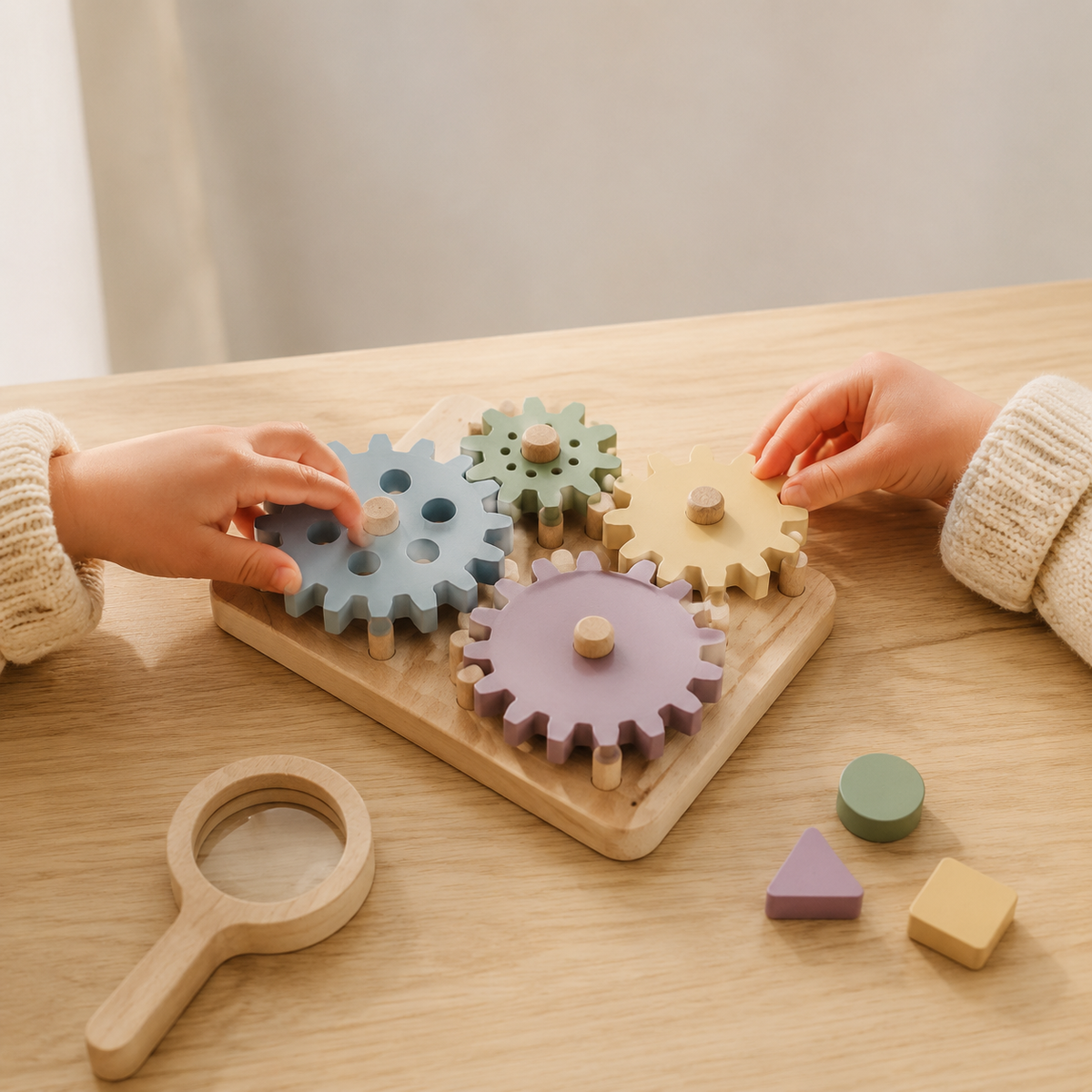
The word Montessori appears everywhere. It is used to describe wooden puzzles, stacking toys, busy boards, climbing equipment and sometimes almost anything painted in neutral colours.
But a toy does not become Montessori simply because it is wooden, beige or described that way on its packaging.
Montessori is a complete educational approach centred on independence, purposeful hands-on activity, careful observation and an environment prepared for the child’s stage of development. At home, “Montessori-inspired” is often the more accurate term for toys and gifts influenced by these principles.
You do not need to recreate a classroom or buy specialist materials to make a thoughtful choice. The useful question is not “Does this look Montessori?” but:
“What can this particular child do with it?”
What makes a good Montessori-inspired gift?
A good Montessori-inspired gift usually:
-
invites active, hands-on participation;
-
matches the child’s current abilities and interests;
-
supports independent use;
-
has a clear, understandable purpose;
-
offers an achievable level of challenge;
-
allows repetition;
-
avoids unnecessary electronic effects;
-
can be stored where the child can reach it;
-
is safe and appropriate for the child’s age.
The best choice is not necessarily the most expensive or visually minimal. It is the one that offers the child something meaningful to explore, practise or master.
The American Montessori Society describes Montessori as a child-centred educational approach involving hands-on learning, self-directed activity and carefully prepared environments. A single toy cannot represent the complete method, but it can reflect some of its principles.
1. Choose a gift the child can act upon
A useful Montessori-inspired toy does not do all the interesting work while the child watches.
The child might:
-
sort;
-
stack;
-
match;
-
thread;
-
open and close;
-
pour;
-
carry;
-
balance;
-
build;
-
assemble;
-
take apart;
-
try again.
A toy with numerous sounds, lights and automated responses may be entertaining, but the child’s role can be limited to pressing a button.
A simpler object may offer more meaningful activity because the result depends on what the child does with it.
Before buying, ask:
-
What action does this invite?
-
Can the child understand what to do?
-
Is there more than one useful way to engage with it?
-
Will the child remain an active participant?
2. Match the challenge to the child
Age recommendations are an important starting point, but children of the same age do not necessarily have identical interests or abilities.
A toy that is too easy may be ignored. One that is far beyond the child’s current skills may require constant adult intervention and quickly become frustrating.
Look for a challenge that the child can begin with some confidence while still having something new to discover.
Consider:
-
what the child already enjoys;
-
what they can currently manage independently;
-
whether the activity requires fine or gross motor control;
-
how many steps are involved;
-
whether an adult must assemble or reset it;
-
whether the child is likely to return to it.
Buying far ahead of the child’s stage can be tempting, particularly when a product promises years of use. However, a gift becomes valuable when the child can engage with it now—not only at some undefined point in the future.
3. Prefer a clear purpose to a long feature list
Many Montessori materials isolate one concept or skill. This helps the child focus on a particular action without unrelated distractions.
A home toy does not need to copy a classroom material exactly. It can still offer a clear experience, such as:
-
placing shapes into corresponding openings;
-
arranging objects by size;
-
threading large pieces;
-
fitting puzzle pieces into place;
-
pouring between child-sized containers;
-
balancing on a stable surface;
-
caring for a plant;
-
preparing a simple snack.
More features do not automatically create more learning. Sometimes they simply make it harder for the child to understand where to begin.
4. Allow room for repetition
Adults can find repetition tedious. Children often use it to understand how something works.
A child may complete the same puzzle, open the same fastening or build the same tower many times. Each repetition may become slightly more controlled, confident or efficient.
Choose gifts that can withstand regular use and do not depend on a constant supply of new instructions or entertainment.
Repetition should remain voluntary. The purpose is not to make the child perform the activity until they have “mastered” it for an adult. The child should be free to return to it, leave it and rediscover it later.
5. Look for useful feedback
Some formal Montessori materials allow children to notice when something does not fit or when a sequence is incomplete. This is often called control of error.
The adult does not always need to announce that something is wrong. The design itself provides information, allowing the child to observe and try again.
At home, this might appear in:
-
a puzzle piece that fits only in the correct space;
-
a container that holds a specific number of objects;
-
a sorting activity with recognisable categories;
-
stacking pieces that reveal an unstable arrangement;
-
matching cards with clear visual relationships.
Not every good toy needs to be self-correcting. Open-ended toys serve a different purpose and may have no single correct result.
The important point is to understand what kind of play or learning experience the gift offers.
6. Support independence through the environment
A good activity is difficult to use independently if it is stored on a high shelf, mixed with dozens of other toys or missing essential pieces.
How the gift is presented matters almost as much as the object itself.
Try to:
-
place it where the child can reach it safely;
-
keep all necessary pieces together;
-
offer one complete activity;
-
demonstrate slowly if guidance is needed;
-
use as few words as possible during the demonstration;
-
allow the child time to explore;
-
provide a clear place for returning it afterwards.
The Association Montessori Internationale describes the prepared environment as one designed to support children’s independence and activity. At home, this can be as simple as a low shelf, a small tray and an uncluttered place to work.
Montessori-inspired gift ideas by age
Age categories are broad guides, not strict developmental promises. Always check the individual product’s age recommendation and safety information.
Babies from birth to 12 months
For babies, look for simple sensory and movement experiences suited to their current stage.
Possible gifts include:
-
grasping toys;
-
lightweight rattles;
-
high-contrast visual materials;
-
soft sensory objects;
-
simple rolling toys;
-
sturdy board books;
-
baby-safe mirrors.
Avoid toys with loose pieces, long cords or components that are not designed for mouthing. Follow the product’s exact age and supervision guidance.
Explore gifts for babies aged 0–12 months.
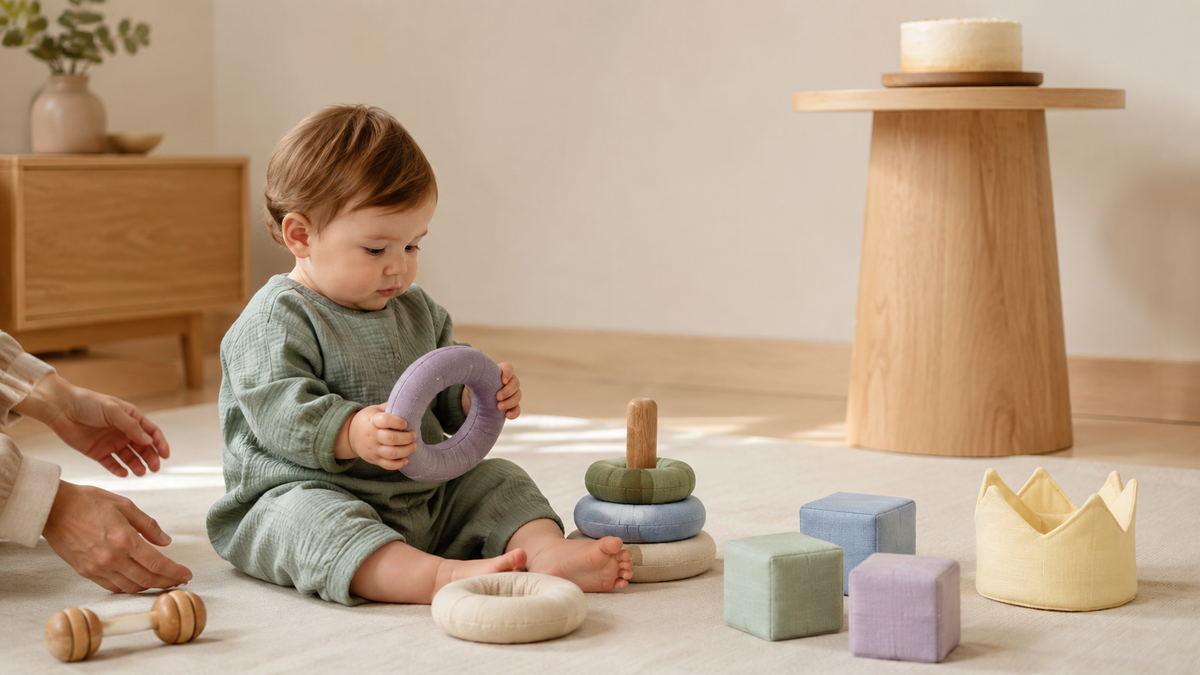
Toddlers aged 1–2 years
Toddlers often enjoy repeating practical actions and moving objects from one place to another.
Suitable ideas may include:
-
simple shape sorters;
-
large stacking toys;
-
posting activities;
-
beginner puzzles;
-
large threading pieces;
-
push-and-pull toys;
-
child-sized cleaning tools;
-
simple busy boards;
-
stable movement equipment.
Choose generous, easy-to-handle pieces and check carefully for small-part hazards.
Explore gifts for children aged 1–2 years.
Children aged 3–5 years
Children in this age group may enjoy more detailed practical-life activities, construction, imaginative play and early problem-solving.
Consider:
-
puzzles with an appropriate number of pieces;
-
building sets;
-
sorting and matching games;
-
simple craft tools;
-
gardening equipment;
-
child-sized kitchen tools;
-
balance equipment;
-
nature observation sets;
-
open-ended wooden toys.
At this age, the child’s interests become especially important. A beautifully designed sorting toy will not necessarily appeal to a child currently fascinated by insects, cooking or construction.
Explore gifts for children aged 3–5 years.
Children aged 6–10 years
Older children may be ready for activities involving planning, precision and several connected steps.
Ideas include:
-
more complex construction sets;
-
science and nature kits;
-
detailed craft projects;
-
measuring and cooking tools;
-
strategy games;
-
woodworking activities designed for children;
-
sewing or weaving sets;
-
gardening projects;
-
equipment for independent creative work.
A Montessori-inspired gift for an older child should respect their growing competence. Avoid choosing something that looks educational but feels too young for them.
Explore gifts for children aged 6–10 years.
Useful Montessori-inspired gift categories
Stacking and sorting toys
Stacking and sorting activities can invite children to compare size, shape, colour, order and balance.
Look for pieces the child can handle comfortably and an activity that matches their current level. A toddler may need a simple stacker with large components, while an older child may enjoy a construction challenge with many possible arrangements.
Puzzles
A suitable puzzle provides a clear challenge without requiring an adult to complete most of the work.
Consider:
-
the number and size of the pieces;
-
whether the images are easy to recognise;
-
the child’s previous puzzle experience;
-
whether the pieces provide useful visual or physical feedback;
-
whether the subject interests the child.
Practical-life gifts
Practical-life activities connect play with participation in everyday family routines.
Depending on the child’s age and supervision needs, a gift might include:
-
a small watering can;
-
a child-sized brush;
-
simple food-preparation tools;
-
a gardening set;
-
a pouring jug;
-
a sewing or threading activity;
-
containers for organising personal belongings.
The aim is meaningful participation, not perfect results.
Movement and balance equipment
Climbing, balancing and movement equipment can support active indoor or outdoor play.
Before purchasing, check:
-
age and weight guidance;
-
required supervision;
-
stability;
-
available floor space;
-
safety clearance;
-
installation requirements;
-
whether protective flooring is recommended;
-
care and inspection instructions.
“Montessori” in the product title does not replace these practical checks.
Child-sized furniture
A low table, accessible storage unit or child-sized chair can make independent activity easier.
Furniture should be stable, suitable for the child’s proportions and positioned safely. Choose according to the available space and how the family will actually use it, rather than trying to reproduce a perfectly styled Montessori room.
Nature and science gifts
Magnifiers, gardening tools, observation containers, nature books and age-appropriate science materials can encourage careful exploration of the real world.
These gifts work best when they connect with something the child can observe or do, rather than presenting facts without active involvement.
What is not automatically Montessori?
Wooden does not automatically mean Montessori
Wood can be durable, tactile and attractive, but the material alone says little about how a toy is used.
A plastic pouring jug that fits a child’s hands may support independence more effectively than a heavy wooden object chosen mainly for appearance.
Neutral colours are not required
Montessori materials often use colour purposefully. Bright colours are not incompatible with thoughtful, focused activity.
A calm palette may suit the family’s home, but it should not be confused with educational value.
Open-ended and Montessori are not identical
Open-ended toys allow many possible uses and outcomes. Traditional Montessori materials often have a defined purpose and carefully designed sequence.
Both can be valuable, but they offer different experiences.
Read What Are Open-Ended Toys? for a fuller explanation.
Expensive does not mean better
A thoughtful Montessori-inspired gift does not need to be costly. Everyday objects can support sorting, pouring, cleaning, cooking and organising when they are safe and appropriate for the child.
The quality of the activity matters more than the price or label.
Red flags when choosing a Montessori toy
Be cautious when a product:
-
relies mainly on the word Montessori without explaining how it is used;
-
makes broad claims about intelligence or development;
-
promises to make a child learn faster;
-
includes too many unrelated features;
-
requires an adult to operate most of it;
-
does not provide clear age or safety information;
-
contains pieces unsuitable for the intended age;
-
looks attractive but offers no meaningful action;
-
needs to be used in only one highly scripted way;
-
is marketed through pressure or fear.
No toy can guarantee developmental outcomes. Children learn through many experiences, relationships, routines and forms of play.
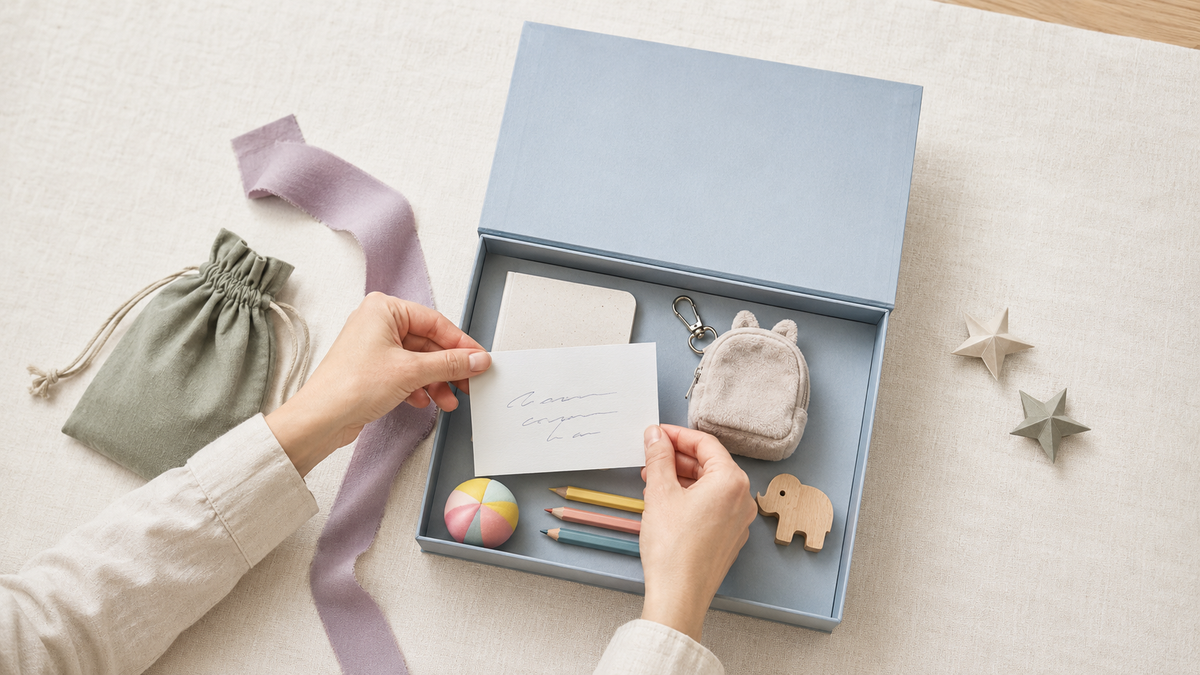
How to present the gift
Begin with one complete activity rather than introducing several new toys at once.
If the child needs guidance:
-
Sit where they can see your hands.
-
Demonstrate the activity slowly.
-
Avoid giving a long explanation.
-
Invite the child to try.
-
Step back and allow time.
-
Help only when necessary or requested.
Do not insist that the child use the gift immediately or in the way you expected. Interest may appear later, particularly when the activity is accessible and the child sees it used naturally.
A final checklist before buying
Ask:
-
Does the activity suit the child’s current abilities?
-
Does it connect with a genuine interest?
-
What will the child actually do?
-
Can they begin independently?
-
Is the challenge achievable?
-
Is the age guidance appropriate?
-
Are the pieces safe for the child and younger siblings?
-
Is adult supervision required?
-
Do we have space to use and store it?
-
Will it complement toys and materials the child already owns?
-
Am I choosing it for the child or for the way it will look in the room?
If the answers are clear, the gift is more likely to become part of the child’s real life instead of remaining untouched on a shelf.
Choose the child, not the label
A thoughtful Montessori-inspired gift supports action rather than performance.
It does not need to announce that it is educational. It does not need to match a neutral playroom or promise extraordinary results.
It needs to offer the child a meaningful opportunity to try something for themselves.
Observe what the child already enjoys. Choose an appropriate challenge. Make the activity accessible and give them enough time to explore without being constantly corrected.
That is often more valuable than choosing a product simply because Montessori appears in its name.
Browse Montessori-inspired educational toys, or use the Gravitaly Gift Finder to explore ideas by age and interest.
GRAVITALY JOURNAL