Choosing a gift for a child aged three to five sounds wonderfully simple—until you stand in front of hundreds of colourful options and realise that small children can have surprisingly big opinions.
At this age, children are busy becoming themselves. They invent entire worlds before breakfast, ask “why?” approximately seventeen times per minute and may transform a cardboard box into a rocket, castle or veterinary clinic.
The best gifts for 3–5-year-olds give that growing imagination somewhere to go. They invite children to move, create, pretend, experiment and return to the same play experience in new ways.
Quick answer: What are the best gifts for children aged 3–5?
The best gifts for 3–5-year-olds include:
-
Open-ended toys that can be played with in different ways
-
Role-play costumes, tents and pretend-play accessories
-
Creative toys that encourage drawing, storytelling or photography
-
Montessori-inspired toys for independent exploration
-
Balance and climbing toys for active indoor play
-
Sensory toys for satisfying, hands-on fun
-
Practical gifts made personal through colour or character
-
Cosy room accessories that support reading and bedtime routines
The right choice depends less on whether a toy looks impressive and more on how naturally it fits the child’s interests, abilities and everyday life.
Explore the complete Gravitaly collection for children aged 3–5, or continue reading for ideas chosen around the way preschoolers actually play.
Why ages 3–5 are such a magical stage for giving
Between three and five, a child’s world expands quickly.
Language becomes richer. Pretend play becomes more detailed. Physical confidence grows, and children begin testing what their bodies can do. They are also learning how to wait, take turns, follow simple sequences and manage some very large emotions in very small bodies.
A thoughtful gift can support this development without feeling like homework.
That distinction matters. Children do not need every toy to “teach” them something in an obvious way. Meaningful learning often happens quietly while they build an obstacle course, photograph the family dog or declare that the sofa is now a pirate ship.
The most valuable gifts make room for curiosity. They do not prescribe every move.
1. A first camera for the little observer
Adults often rush through places children find fascinating. A shiny pebble, a crooked leaf or the shadow of a chair can become the most important discovery of the afternoon.
A child-friendly camera allows preschoolers to capture the world from their own wonderfully unusual perspective.
The Hoppstar Rookie Kids Digital Camera is designed for children aged three and over, with an easy-to-hold shape and simple controls for small hands. It turns walks, holidays and quiet afternoons at home into creative expeditions.
Instead of directing the child, offer a playful mission:
-
Photograph five red things
-
Find the funniest face in the house
-
Create a picture story about a favourite toy
-
Take one photo that shows what “happy” looks like
-
Make a tiny nature gallery after a family walk
A camera is especially meaningful for curious children who enjoy observing, collecting and telling stories.
Best for: curious explorers, young storytellers and children who notice every tiny detail.
2. A wooden balance beam for the child who rarely stops moving
Some children seem to have springs in their socks.
They climb the arm of the sofa, hop over pavement lines and turn the journey from the bedroom to the kitchen into a full obstacle course. Movement is not simply a way to spend their energy—it is one of the ways they explore and understand their capabilities.
The Wooden Balance Beam with 5 Elements can be arranged in different configurations for walking, balancing and imaginative games. Turn the pieces over, and they can also become roads for toy cars.
Recommended for confident walkers and children up to six years old, it offers an age-appropriate physical challenge while staying low to the ground.
For an expanded course, the 6-Element Wooden Balance Beam provides even more possibilities.
Try using the beam as:
-
A bridge over a pretend crocodile river
-
A path through an enchanted forest
-
A delivery route for toy animals
-
Part of an indoor movement circuit
-
A road connecting two block-built towns
Active gifts work best when children are allowed to adapt them. Today it is a balance path; tomorrow it may be the border of a royal kingdom.
Best for: active preschoolers, indoor adventurers and children developing confidence through movement.
3. A Montessori stacking toy for open-ended discovery
The simplest-looking toys often have the longest play lives.
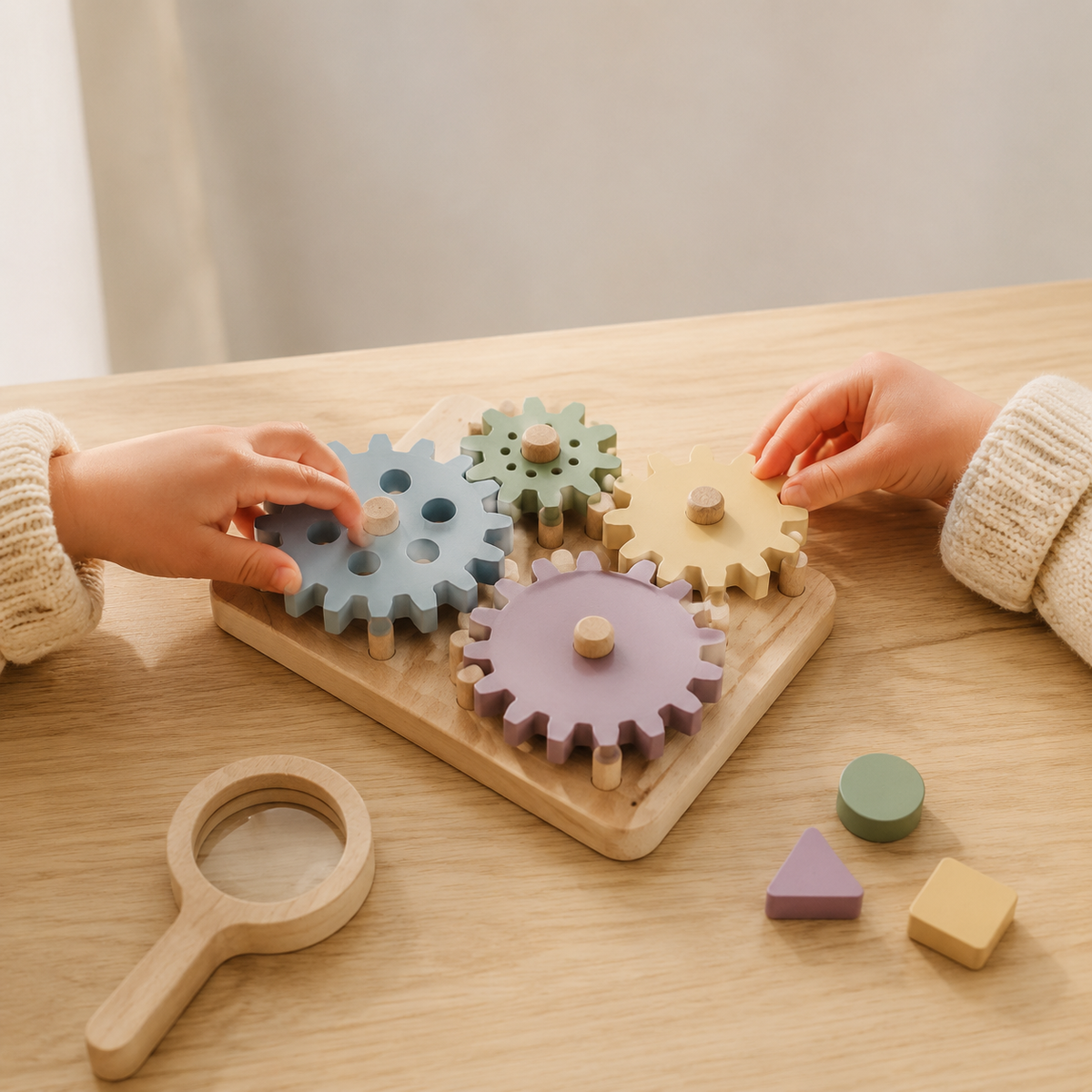
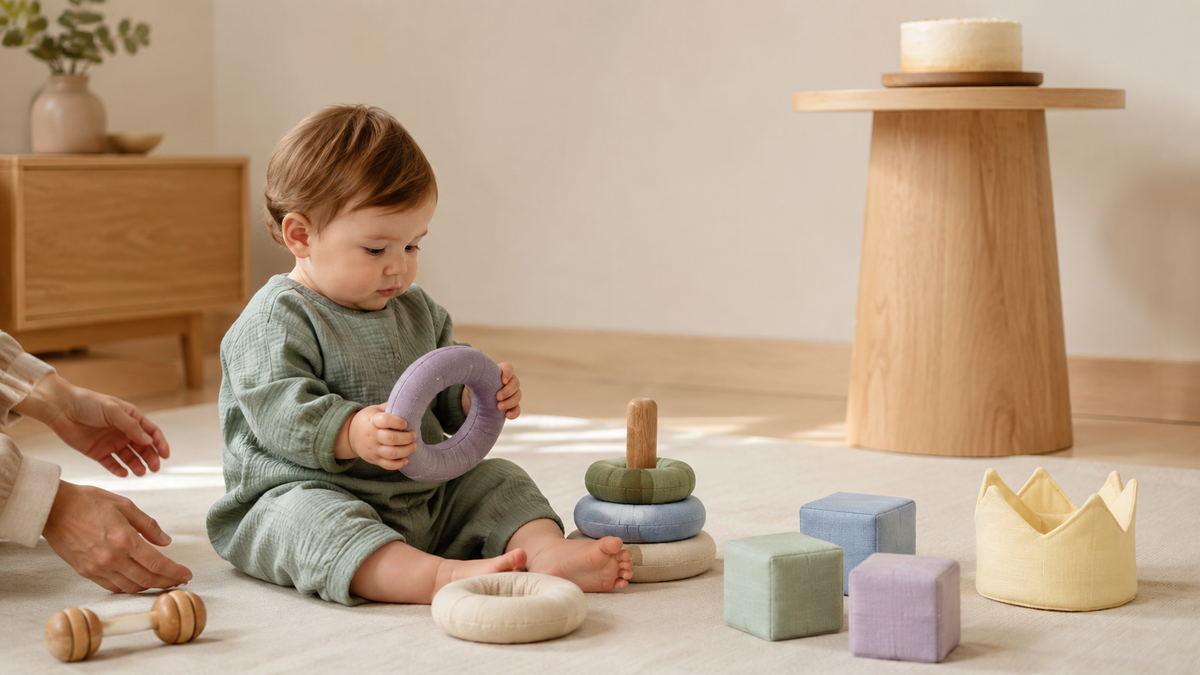
A Montessori Modern Stacking Toy gives children the freedom to arrange, balance, compare and rebuild without chasing one predetermined result.
During play, a child may explore size, order, symmetry, colour and cause and effect. Yet from their perspective, they are simply testing an important theory: “What happens if I put this piece here?”
That is exactly the kind of independent experimentation preschoolers need.
Stacking toys can become:
-
Towers and imaginary buildings
-
Beds for tiny figures
-
Ingredients in a pretend kitchen
-
Pieces in a colour-sorting game
-
Props in a made-up story
Choose this type of gift for a child who enjoys quiet concentration, arranging objects or repeating an activity until it feels just right.
Best for: thoughtful builders, pattern lovers and children who enjoy working things out independently.
4. A play tent for stories, secrets and quiet moments
A tent is more than a beautiful addition to a child’s room.
To a preschooler, it can be a castle, campsite, shop, spaceship, reading den or private place to recover after a busy day. That last function is easy to overlook. Young children are surrounded by noise, instructions and new experiences. A small, cosy space can give them a welcome sense of control.
The Gravitaly play tents and hideaways collection includes thoughtfully designed spaces for imaginary play and quiet time.
The Native Vibe Kids Teepee Tent and Mat, for example, creates a generous hideaway for reading, dreaming and role play. Its cotton construction and coordinated mat make it feel like a real little room within the room.
Add a few well-chosen companions:
-
Two favourite books
-
A soft toy
-
A small basket of costumes
-
Battery-operated fairy lights suitable for the space
-
A cushion or blanket
Try not to fill every corner. An uncluttered tent leaves room for the child to decide what it should become.
Best for: imaginative children, little readers and preschoolers who appreciate a cosy retreat.
5. A dress-up gift for the child who becomes someone new every day
One minute they are a doctor. Then a dragon. Then the owner of an ice-cream shop that accepts leaves instead of money.
Pretend play helps children explore roles, practise language and process experiences they do not yet have the words to explain directly. It can also help them experiment with courage, kindness, leadership and cooperation.
A special cape or costume from the Gravitaly dress-up collection gives those stories an exciting starting point.
The Cosmic Pearl Magic Cape is made for dramatic entrances, magical missions and afternoons when walking normally from one room to another simply will not do.
Dress-up gifts become even more engaging when paired with an invitation rather than an instruction:
“I wonder who wears this cape—and what important adventure they are about to begin?”
Then step back. Children are usually excellent directors.
Best for: performers, storytellers, superhero fans and children with vivid imaginations.
6. A rocker and slide for big-body play at home
Preschoolers need opportunities to climb, balance, push, pull and test physical ideas. When outdoor time is limited, a versatile indoor play structure can become one of the most frequently used gifts in the home.
The White Wooden Dream Rocker with Pillow, Slide and Ladder combines several possibilities in one design. It can become a rocker, climbing arch, slide, ramp, cosy lounger or prop for imaginative play.
That flexibility is what helps a substantial gift earn its place in the home.
Before choosing a larger active-play product, consider:
-
The available floor space
-
Where it will be stored
-
The child’s current physical confidence
-
Whether adult supervision is practical
-
Whether siblings are likely to use it together
A large present does not need flashing lights or constant novelty. It needs enough possibilities to remain interesting as the child grows.
Best for: energetic children, confident climbers and families creating an indoor movement area.
7. Sensory toys for small hands and busy moments
Sensory gifts provide an immediate, satisfying play experience. Children can squeeze, stretch, press and explore different textures without needing complex rules.
Gravitaly’s squishy and fidget toy collection includes playful designs that work well as smaller birthday presents, travel companions or additions to a personalised gift box.
A Surprise Squishy Box adds the delight of discovery, while characterful options such as the Giant Strawberry Squishy are difficult for small hands to ignore.
Sensory toys can be particularly useful during:
-
Long journeys
-
Restaurant waits
-
Quiet-time baskets
-
Transitions between activities
-
Calm play beside a parent
-
Small celebrations and party gifts
Always check the individual product’s age recommendation and supervise play according to the instructions, especially when smaller components are involved.
Best for: tactile explorers, collectors and children who love gifts with an element of surprise.
8. A practical gift with a favourite animal friend
A practical present does not have to feel disappointingly sensible.
For a child preparing for nursery, preschool or regular family adventures, a bottle, lunch bag or backpack featuring a cheerful animal can become part of a daily independence ritual.
Children aged three to five often feel proud when they can carry their own belongings, recognise their bag and take responsibility for small tasks.
Explore:
A practical gift is especially thoughtful when it reflects the child’s personality. Is their imaginary companion more likely to be a lion, butterfly, dragon or shark?
Letting the child choose between two suitable designs can make the gift feel genuinely theirs without overwhelming them with options.
Best for: preschool starters, little travellers and children who enjoy doing things “all by myself.”
9. A night light for softer bedtime transitions
Not every wonderful gift needs to create noise and excitement.
For children who are beginning to notice shadows, imagine creatures in dark corners or simply prefer a gentle glow at bedtime, a carefully chosen night light can bring comfort to the evening routine.
The handcrafted Little Lights Wooden Hedgehog Night Light provides a warm glow and includes dimmer and timer functions. Its LED lighting does not heat up, and the wooden design also works as a charming feature in the child’s room.
A night light can become part of a predictable bedtime rhythm:
-
Put toys to sleep.
-
Choose one story.
-
Turn on the little hedgehog.
-
Share the best moment of the day.
-
Say goodnight in the same familiar way.
For a child, consistency can feel like a warm blanket. The object matters, but the loving ritual built around it matters even more.
Best for: bedtime-story lovers, children moving into their own room and families creating calmer evening routines.
10. A gift built around the child—not the trend
The most thoughtful present may not be the toy currently appearing everywhere.
It is the one that quietly says, “I see who you are.”
For the child who builds: choose an open-ended construction or stacking toy.
For the child who performs: choose a cape, puppet theatre or role-play accessory.
For the child who moves: choose a balance beam, rocker or ride-on.
For the child who observes: choose a first camera or nature-inspired activity.
For the child who needs a little nest: choose a tent, soft toy or comforting room light.
When you match the gift to the child instead of the latest trend, the present feels more personal—and is much more likely to be used after the birthday balloons have disappeared.
How much should you spend on a gift for a 3–5-year-old?
There is no correct amount.
A meaningful gift can be small and delightfully silly, or it can be a larger item chosen by several family members together. The right budget is one that feels comfortable and appropriate for your relationship with the child.
A useful approach is to choose by purpose:
Under €20
Look for squishies, small sensory toys, creative accessories or practical little gifts. Browse gifts for children under €20.
€20–€60
Consider role-play accessories, selected wooden toys, backpacks, bottles, soft toys and creative kits.
€60–€150
This range may include cameras, balance boards, balance beams and more substantial open-ended toys.
Over €150
Play tents, climbing structures and multifunctional indoor play furniture can make memorable shared gifts from grandparents, relatives or a group of friends.
A higher price does not automatically make a better gift. Play value, suitability and longevity matter more than the size of the box.
What to check before buying
Before adding a gift to your basket, take one quiet minute to check:
-
The manufacturer’s recommended age
-
Whether the toy contains small parts
-
The amount of adult supervision required
-
The product dimensions
-
The space available in the child’s home
-
Whether batteries or extra accessories are needed
-
The child’s abilities and interests
-
Whether the family already owns something similar
Age labels are important safety guidance, but children within the same age group still develop at different rates. A confident five-year-old climber and a cautious three-year-old observer may need very different gifts—and both choices can be exactly right.
A note for parents who worry about choosing “the perfect gift”
You do not need to find a toy that develops every skill, matches the room perfectly, guarantees years of use and produces a cinematic reaction the moment it is opened.
That is a lot of pressure to place on one present—and on yourself.
Children often remember something much smaller: who sat on the floor and played with them, who listened to the story behind their drawing, or who agreed to crawl into the tent even though their knees strongly objected.
Choose thoughtfully. Check the practical details. Then let the gift become part of a shared moment.
That is where much of its real value begins.
Frequently asked questions
What do children aged 3–5 enjoy playing with?
Children aged three to five often enjoy pretend play, dressing up, building, drawing, simple photography, sensory exploration and active games. Open-ended toys are particularly valuable because children can use them in different ways as their abilities and stories develop.
What is a good birthday present for a 3-year-old?
Good birthday presents for a three-year-old include age-appropriate stacking toys, simple role-play accessories, sensory toys, first cameras designed for children aged three and over, and low active-play equipment suitable for the child’s ability.
What is a good gift for a 4-year-old?
Many four-year-olds enjoy gifts that support imaginative independence, such as tents, costumes, creative materials, cameras, building toys and balance equipment. Use the child’s current interests as the starting point.
What is a good gift for a 5-year-old?
A five-year-old may appreciate more elaborate role play, creative challenges, photography, active indoor toys or practical accessories for school and outings. Avoid choosing only by age—personality and interests remain more useful guides.
Are Montessori toys good gifts for preschoolers?
Montessori-inspired toys can be excellent gifts when they encourage hands-on exploration, independence and concentration. Look for simple, well-made products that allow the child to discover rather than merely press a button and watch.
How many toys should I give?
One thoughtfully chosen main gift is often enough. If you want the unwrapping experience to feel fuller, pair it with a book, small sensory toy or practical accessory instead of buying several unrelated toys.
What is the best gift for a preschooler who already has many toys?
Choose an experience-enabling gift rather than another single-purpose toy. A first camera, play tent, costume, balance course or personalised set built around the child’s interests can offer new ways to play without simply adding more clutter.
Find a gift that feels like them
The best gift for a child aged three to five does not need to do everything.
It only needs to open the right little door—to movement, imagination, creativity, comfort or discovery.
Explore gifts for children aged 3–5, or use the Gravitaly Gift Finder to narrow the choice by age, interest and budget.
Because somewhere between the wrapping paper, the delighted squeal and the first invented game, a present stops being simply an object.
It becomes part of their world.
GRAVITALY JOURNAL