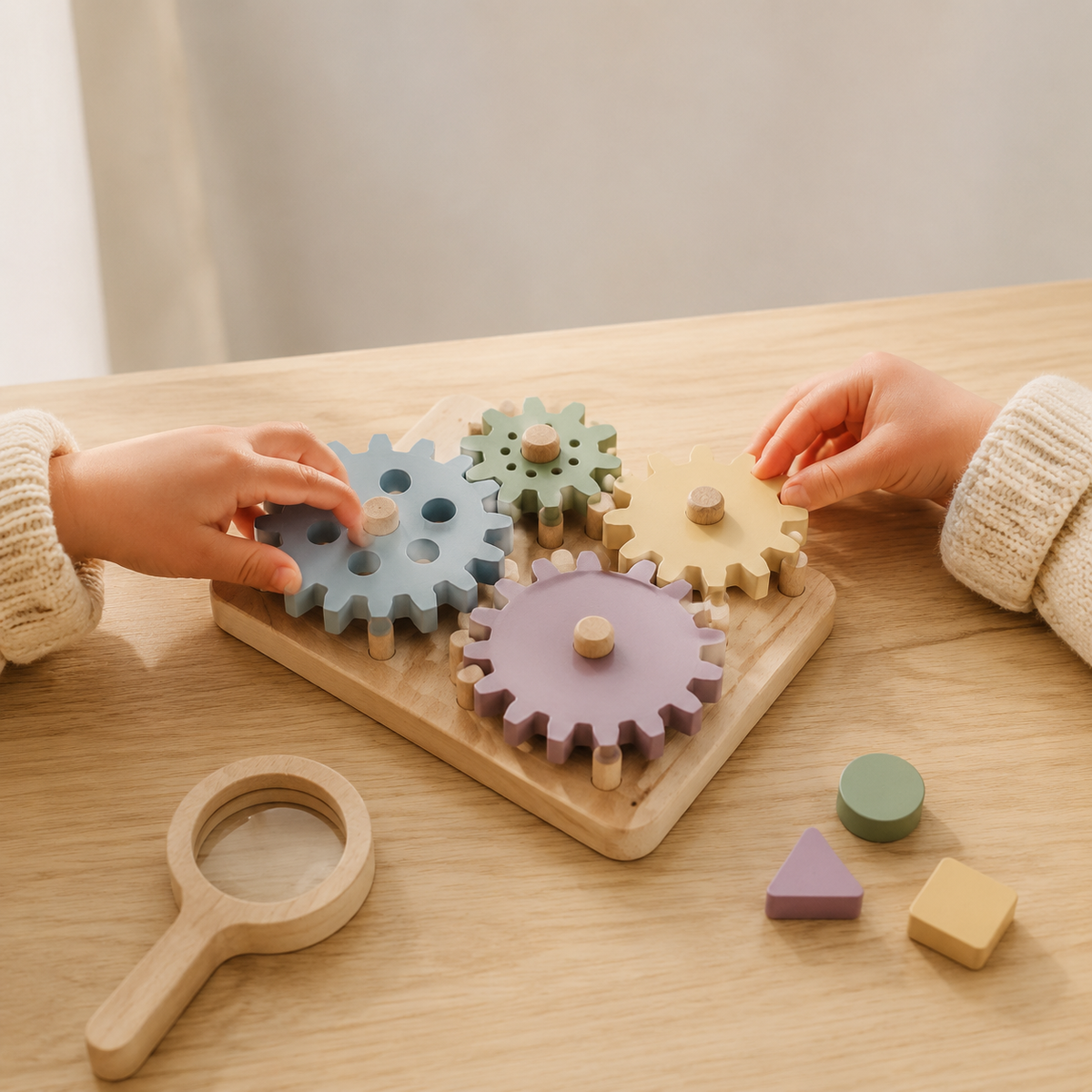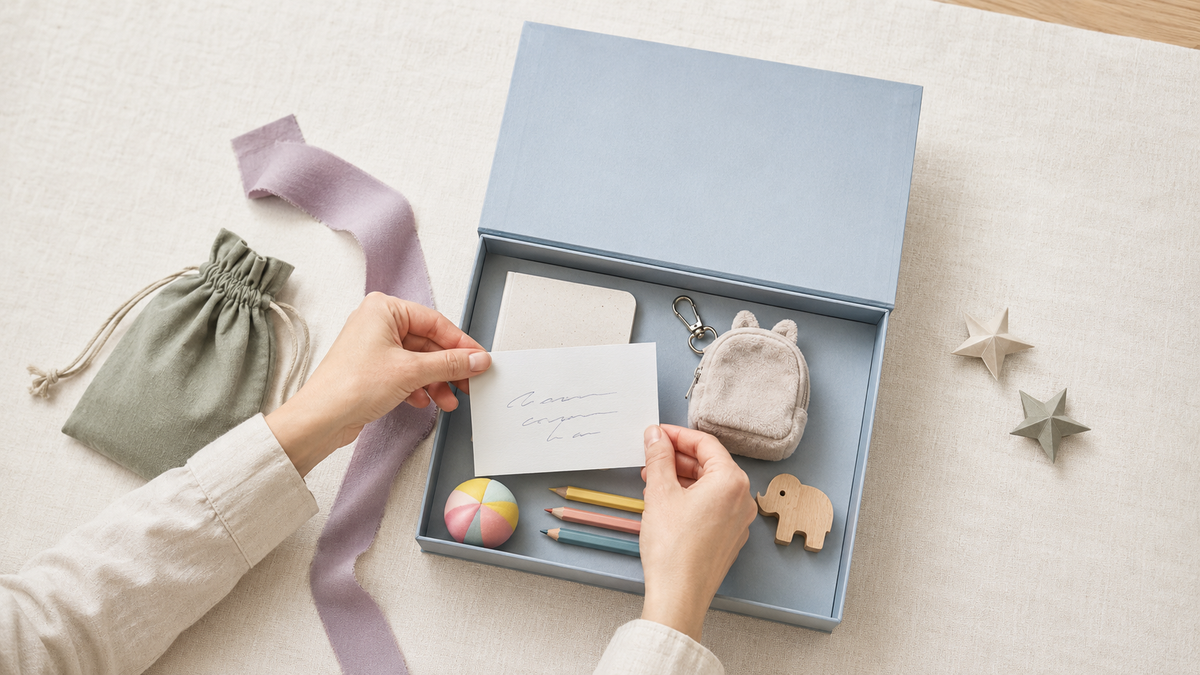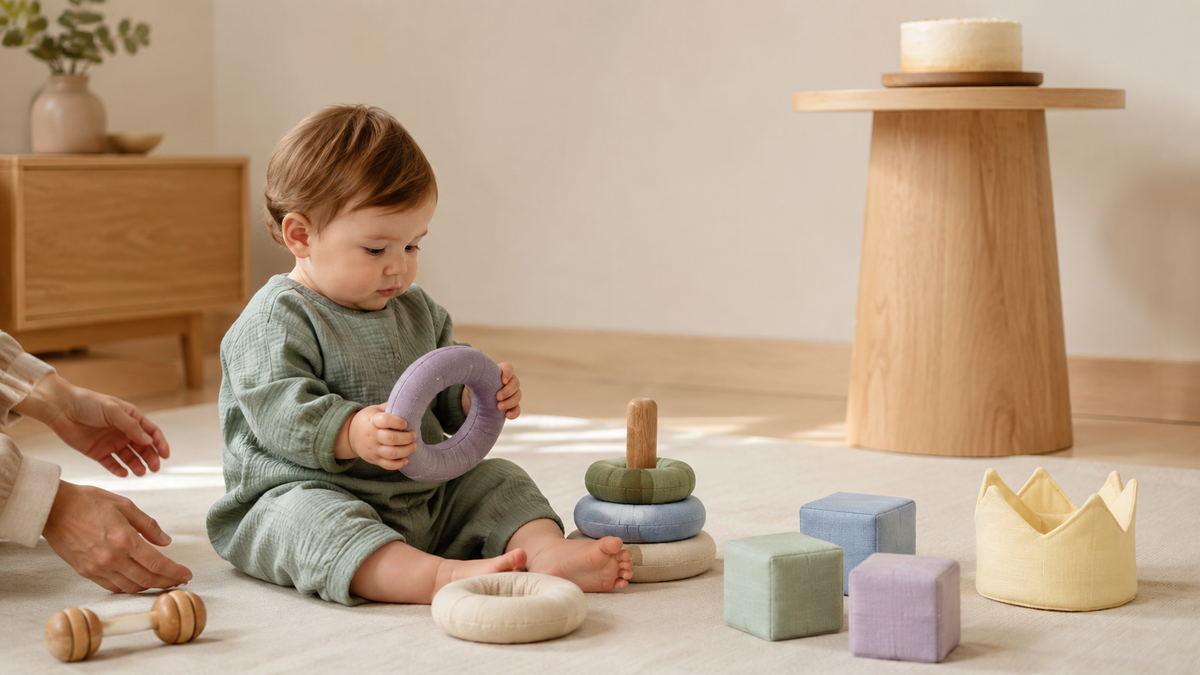
A first birthday is a curious celebration. The child may be more interested in the ribbon, the cardboard box or a piece of cake than in the present everyone carefully chose.
For the adults, however, the day carries a little more weight. It marks a year of first smiles, tired mornings, unexpected discoveries and enormous change.
The best first birthday gift does not need to create the biggest reaction in the room. It should suit the child as they are now while offering new possibilities to explore in the months ahead.
Quick answer: What are the best first birthday gifts?
Thoughtful gifts for a one-year-old include:
- Large stacking and nesting toys
- Soft blocks and simple cause-and-effect toys
- Age-appropriate push, pull and movement toys
- Practical feeding essentials
- Baby play and activity products
- Books and reading-corner additions
- Blankets and useful nursery textiles
- Family experiences and keepsakes
The most important rule is simple: choose for the child’s current abilities, not for what adults expect them to do next.
Always follow the individual product’s official age recommendation, warnings and instructions. A first birthday does not make a toy marked 3+ suitable for a one-year-old.
Explore toys and gifts for children aged 1–2, or use the Gravitaly Gift Finder to browse by age, interest and budget.
What is a one-year-old learning to do?
Children reach their first birthday with very different abilities.
Some are walking. Others are crawling at impressive speed. Some prefer to sit and examine objects carefully, while others want to carry, drop or push everything they can reach.
Around this stage, a child may be exploring:
- Grasping and releasing
- Moving objects between hands
- Placing objects into containers
- Crawling, cruising or walking
- Cause and effect
- Object permanence
- Early problem-solving
- Sounds, gestures and first words
- Imitation
- Growing independence during meals and play
Development does not follow an exact birthday schedule. A suitable gift should offer a manageable next step without expecting the child to perform a skill they have not yet developed.
1. Stacking and nesting toys
Stacking toys are classic first birthday gifts because they can be explored at several levels.
At first, the child may simply hold the pieces, remove them from a base, pass them between hands or knock down a small tower built by an adult. Later, they may begin placing, ordering and stacking independently.
Look for:
- Large pieces designed for the child’s age
- Simple shapes that are easy to grasp
- Durable construction
- Interesting but not overwhelming colours or textures
- Pieces that can be used in more than one way
The child does not need to stack everything correctly for the toy to be valuable. Removing the pieces may be the entire game for now — and that is perfectly appropriate.
Best for: curious hands, repeated experimentation and early placing activities.
2. Soft blocks and simple construction toys
One-year-olds do not begin construction play by building elaborate castles. They begin by exploring shape, weight, texture and what happens when two objects meet.
A child may place one block on top of another and remove it immediately. That is not a failed building project. It is the beginning of understanding balance and position.
Choose blocks that are officially suitable for the child’s age, easy to handle and free from detachable small components.
Simple blocks can later become:
- Small towers
- Objects to place into containers
- Pieces to roll or transport
- Props in early pretend play
- Parts of a sorting or matching activity
Browse Baby Play & Activity Essentials for early-years play ideas, checking every product’s individual age and safety information.
Best for: hands-on discovery, early building and children who enjoy repeating actions.
3. A push, pull or movement gift
Around the first birthday, physical abilities vary enormously. A movement toy that is suitable for one child may be too early for another.
Depending on its design, a one-year-old may enjoy pushing, pulling, transporting objects or moving alongside a stable toy. Ride-ons and climbing products may require greater walking confidence, specific height or weight ranges and close adult supervision.
Before choosing a movement gift, check:
- Whether it is designed for new or confident walkers
- The official minimum age
- Height and weight limits
- Stability and intended surface
- Assembly requirements
- The level of adult supervision
- Available play and storage space
A push toy should not be treated as walking support unless the manufacturer specifically designed and approved it for that purpose.
Best for: children who are already interested in moving, carrying and transporting objects.
4. A practical feeding gift
A first birthday gift does not have to be a toy.
Meals provide daily opportunities for children to grasp, scoop, drink, choose and participate. A well-designed feeding item can support a routine the child experiences several times every day.
Useful options may include:
- A bowl or divided plate
- A training cup
- A child-sized spoon
- A bib
- A placemat
- A coordinated feeding set
Before buying, verify the materials, age recommendation, care instructions and suitability for the dishwasher, microwave, freezer or heat where relevant.
Adult supervision remains essential during meals. Growing independence often involves practice — and a reasonable amount of food reaching places nobody intended.
Explore Baby & Kids’ Feeding Essentials.
Best for: practical gifting, daily routines and families who prefer useful presents.
5. A baby play or activity gift
Activity toys can provide simple opportunities to look, reach, touch, grasp, roll or explore cause and effect during supervised play.
The right product depends on the child’s current stage. Options may include:
- Age-appropriate rattles
- Textile grasping toys
- Sensory balls
- Soft play mats
- Simple activity toys
- Large tactile objects
- Soft play elements intended for the correct age
Avoid assuming that every item in a broad baby collection is suitable for every one-year-old. Some products are designed from birth, while others are intended only for older babies, confident sitters or toddlers.
Check product dimensions, installation instructions, detachable components and supervision requirements before ordering.
Best for: sensory exploration, floor play and children who enjoy handling and examining objects.
6. Books and a small reading corner
Books make thoughtful first birthday gifts, but so can a comfortable place where reading becomes part of the day.
A simple reading corner might include:
- One or two sturdy books
- A small front-facing book display
- A washable play mat
- A storage basket
- A comfortable place for an adult to sit nearby
At one, the child may turn several pages at once, point to a single picture or walk away before the story ends. The value is not in completing the book perfectly. It is in building a familiar shared ritual.
Choose room accessories carefully and follow all installation and age guidance. Decorative cords, unstable furniture and unsecured items should remain inaccessible.
Best for: shared routines, quiet moments and gifts that families can use together.
7. A blanket or useful nursery gift
A quality blanket, nursery textile or room accessory can remain useful long after the birthday celebration.
A blanket may become part of supervised cuddling, pram walks, reading time, travel or family photographs. A well-chosen nursery light or storage item can also become part of everyday family life.
Browse Nursery Textiles and Children’s Lighting for longer-lasting room gifts.
Before choosing, consider:
- Materials and care requirements
- Product dimensions
- The family’s available space
- Installation and cable safety
- Whether the item is decorative or intended for direct child use
- How and where it will be used
Blankets, cushions, soft toys and decorative items should only be used as directed. Keep loose objects out of the baby’s sleep space and follow current local safe-sleep guidance.
Ask the parents before purchasing a large or permanent room item. A beautiful gift is less helpful when there is nowhere suitable to install or store it.
Best for: grandparents, close relatives and anyone choosing a practical keepsake.
8. An experience paired with a small object
A one-year-old may not remember the first birthday independently, but the family can create a story that grows around it.
Pair a small physical gift with an experience such as:
- A visit to a garden or aquarium
- A family picnic
- A professional or home photo session
- A tree planted in the child’s honour
- A book read again on every birthday
- A walk repeated each year
- A letter for the child to open later
The object can become a symbol of the experience. A small animal toy might accompany a first zoo visit, while a blanket could appear in birthday-morning photographs each year.
The meaning develops through repetition, not through price.
Best for: families who already have plenty of toys and relatives who want to create a lasting tradition.
First birthday gifts by budget
There is no correct amount to spend. One suitable, well-researched gift is often better than several products competing for the child’s attention and the family’s storage space.
Small, thoughtful gifts
Consider:
- An age-appropriate rattle
- A tactile or grasping toy
- A feeding item
- A sturdy book
- A small soft companion for supervised play
- A contribution to an experience
Mid-range gifts
Consider:
- A stacking or nesting set
- Soft blocks
- A feeding set
- A quality blanket
- A baby play product
- A useful nursery accessory
Larger family gifts
Several relatives may choose one significant present together, such as:
- Age-appropriate movement equipment
- A substantial play-space addition
- A nursery lamp
- Storage or room furniture
- A family photography session
- A contribution toward a longer-term item
Always discuss large gifts with the parents first.
What not to buy for a one-year-old
Avoid giving the child direct access to:
- Toys marked for ages three and over
- Products containing small or detachable parts
- Strong magnets
- Accessible button batteries
- Long cords, loops or ribbons
- Heavy items the child could pull down
- Unstable movement equipment
- Products with unclear age or safety information
- Decorative objects presented as toys
- Feeding products without verified food-contact materials
- Toys chosen only because the child may “grow into them”
It can be reasonable to buy a future gift if the parents agree to store it securely. It should not be offered for play before the child reaches the required age and stage.
Do first birthday gifts need to be educational?
No.
A one-year-old learns through movement, repetition, sensory exploration, imitation and interaction with other people. A toy does not need flashing lights, flashcards or ambitious developmental promises to offer meaningful play.
A ring can be grasped and released. A block can fall. A rattle can respond to movement. A parent can hide an object and reveal it again.
Learning is already part of the experience.
Choose a gift that invites the child to participate rather than one that promises to accelerate development.
Five useful questions to ask the parents
Before choosing a first birthday gift, ask:
- What is the child currently doing physically?
- Which toys or activities do they return to most often?
- Is there anything similar the family already owns?
- Are there materials or product types they prefer to avoid?
- Would they prefer a toy, practical item, room gift or experience?
These questions do not ruin the surprise. They make it more likely that the gift will be useful, safe and welcome.
The first birthday is a beginning, not a performance
A one-year-old does not need to open every present politely or demonstrate its correct use immediately.
They may prefer the wrapping. They may need a nap. They may carry one simple toy around the room while ignoring something larger and more expensive.
That is not ingratitude. It is one-year-old logic.
Choose a gift that can wait — something the child can approach slowly, repeat often and understand in new ways over time.
Explore All Baby & Toddler, browse gifts for children aged 1–2, or use the Gravitaly Gift Finder to find an age-appropriate idea.
GRAVITALY JOURNAL